NEMA17 planetary gearbox
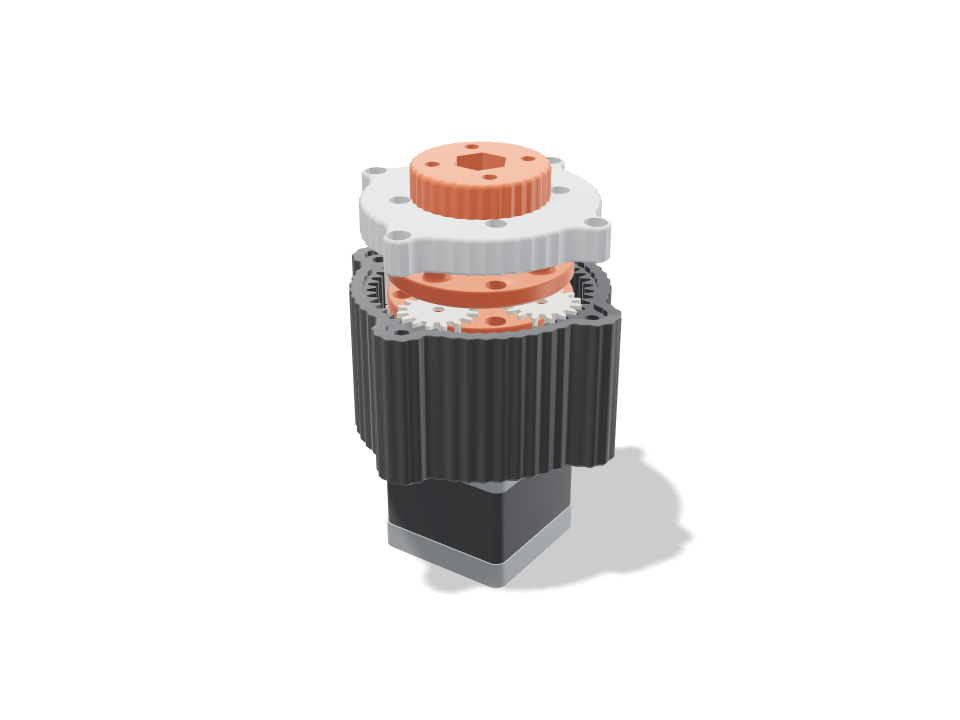
A two-stage planetary gearbox that bolts straight onto a NEMA17 stepper. The first sun presses onto the motor's D-shaft, four planets per stage roll around one shared ring cut into the fluted housing, the first carrier carries the second sun, and the second carrier turns an output flange through an M8 bolt riding in a 608 bearing in the cap. Press play and the shaft spins the sun while the planets orbit and spin and each carrier turns at its real reduced speed. The checks prove the gears stand free at rest and in every sampled pose, the planets are evenly spaced and phased, the teeth (Lewis root stress) and 3 mm steel pins hold the motor's 0.4 N m stall torque through the 16:1 reduction (about 5.4 N m out), and every part has a clear way in. It is a kit: printed parts plus pins, a bearing and a few screws.
Ask for the sizes you want to tweak, e.g. “make the width adjustable”.
Specs at the default size
Measured from the actual build on a Bambu Lab A1 in pla. Every number updates live when you drag a slider above.
- Overall size
- 88 × 88 × 67 mm
- Parts
- 14
- Filament
- 100 g
- Print time
- 3 h 23 min
- Build plates
- 1
- Supports
- None needed
Engineering checks
- Every part stands free at resttotal overlap 0.000 mm³ between gears, carriers, housing and cap with a 0.15 mm flank gap and 0.4 mm axial gaps
- Planets space evenly(16 + 48) / 4 = 16, a whole number, so all four planets mesh in phase
- Planets clear each other5.8 mm between neighbouring planet tips
- No tooth undercutsun/planet 1.00:1 needs 13+ teeth at 20 deg; smallest here 16
- Teeth overlap in meshcontact ratio 1.35 sun-planet, 1.51 planet-ring after the flank gaps (1.2+ runs smoothly)
- Stage 1 teeth take the stall torque5.0 MPa at the tooth root (Lewis, Y 0.296, 8 mm face) with 0.40 N m on its sun shared by 3 of 4 planets; PLA allows 16.7 along the layers
- Stage 1 planet pins hold27 N per pin: 44 MPa bending in the 3 mm hardened dowel (allow 500), 1.1 MPa in the planet bore (keep under ~6), 11.2 MPa in the 5 mm carrier socket vs 16.7
- Stage 2 teeth take the stall torque13.6 MPa at the tooth root (Lewis, Y 0.296, 10 mm face) with 1.47 N m on its sun shared by 3 of 4 planets; PLA allows 16.7 along the layers
- Stage 2 planet pins hold98 N per pin: 200 MPa bending in the 3 mm hardened dowel (allow 500), 3.3 MPa in the planet bore (keep under ~6), 13.9 MPa in the 10 mm carrier socket vs 16.7
- Sun grips the D-shaft6.9 MPa on 9.7 mm of the shaft flat at 0.4 N m vs 16.7; the bore prints ~0.1 mm small for a press fit
- Motor shaft clears all but its sunshaft tip at 24 mm runs in carrier 1's bushing; overlap 0.00 mm³, sun bore 0.01
- Housing bolts to the motorseats on the 22 mm boss; M3x8 bites 4.5 mm into the motor's threads; 62 N per screw from the 5.4 N m reaction, 5.2 MPa on the floor vs 16.7
- Output bolt carries the torque5.4 N m out: 102 MPa shear in the M8 core (8.8 bolt, allow 190); hex pockets 7.0 / 4.6 MPa vs 16.7
- 608 is seated and capturedflush in a 7 mm pocket on a 3.00 mm lip under the outer race; the inner race is clamped between 8 x 12 mm speed rings by the carrier shoulder and the flange, which runs 1.0 mm clear of the cap; overlap -0.00 mm³
- Cap centres on the housingthe cap sits 1.5 mm deep in the housing's bezel with 0.15 mm all round, so the bearing lands on the ring's axis; flat on the ring top; M3x12 into heat-set inserts in the lobes, 1.2 mm of cap round each screw head
- Ring wall4.2 mm under the flutes, 2.3 mm between each insert and the ring's tooth roots, 3.4 mm bezel rim standing outside the tooth roots
- Bolt and nut fitM8 x 30: the nyloc sits 5.9 mm above the flange underside, its top flush with the bolt end; the carrier shoulder passes the 8 mm lip hole with 0.5 mm all round
- Ratio16.00:1 (2 x 4.00, 16/16/48 teeth, module 1.25): 4.0 motor turns = 0.25 output turns; about 5.4 N m out from 0.4 N m at 92% per stage
- NEMA17 stepper goes in23 poses along its path clear of every part.
- NEMA17 end caps goes in23 poses along its path clear of every part.
- 608 bearing (in the cap) goes in6 poses along its path clear of every part.
- 2x M8 speed ring 8 x 12 x 1 goes in15 poses along its path clear of every part.
- M8 x 30 hex bolt goes in13 poses along its path clear of every part.
- M8 nyloc nut (in the flange) goes in15 poses along its path clear of every part.
- 3 mm steel pins, stage 1 goes in10 poses along its path clear of every part.
- 3 mm steel pins, stage 2 goes in10 poses along its path clear of every part.
- 4x M3x8 into the motor goes in15 poses along its path clear of every part.
- 4x M3x12 cap screws goes in15 poses along its path clear of every part.
- driver: motor screws (through the tool holes) goes in20 poses along its path clear of every part.
- driver: cap screws goes in20 poses along its path clear of every part.
Adjustable sizes
| Setting | Default | Range |
|---|---|---|
| Tooth size (module) | 1.25 mm | 1.25–1.75 mm |
| Sun teeth | 16 | 14–20 |
| Planet teeth | 16 | 14–22 |
| Stages | 2 | 1–2 |
| Gear gap (each flank) | 0.15 mm | 0.1–0.25 mm |
Parts list
| Part | Qty | Size (mm) | Filament | Time |
|---|---|---|---|---|
| housing | 1 | 88 × 88 × 44 | 45 g | 1 h 6 min |
| sun 1 | 1 | 22 × 22 × 13 | 2 g | 8 min |
| planet 1-1 | 1 | 22 × 22 × 8 | 2 g | 7 min |
| planet 1-2 | 1 | 22 × 22 × 8 | 2 g | 7 min |
| planet 1-3 | 1 | 22 × 22 × 8 | 2 g | 7 min |
| planet 1-4 | 1 | 22 × 22 × 8 | 2 g | 7 min |
| planet 2-1 | 1 | 22 × 22 × 10 | 2 g | 8 min |
| planet 2-2 | 1 | 22 × 22 × 10 | 2 g | 8 min |
| planet 2-3 | 1 | 22 × 22 × 10 | 2 g | 8 min |
| planet 2-4 | 1 | 22 × 22 × 10 | 2 g | 8 min |
| carrier 1 | 1 | 52 × 52 × 15 | 8 g | 16 min |
| output carrier | 1 | 52 × 52 × 13 | 8 g | 15 min |
| cap | 1 | 80 × 80 × 10 | 15 g | 24 min |
| output flange | 1 | 38 × 38 × 14 | 7 g | 14 min |
How to make it
- Pick the tooth size, sun and planet teeth and one or two stages; the ratio and output torque update in the checks.
- Print the housing, carriers and planets flat side down, the sun teeth down, and the cap and flange flat side down. No supports.
- Press M3 heat-set inserts into the housing lobes, bolt it to the motor with 4x M3x8, press the sun onto the shaft, then drop in planets on their pressed-in 3 mm pins stage by stage.
- Push the M8 bolt up through the output carrier, add a speed ring, lower the cap with the 608 into the bezel, screw it down, then screw the flange with its nyloc nut onto the bolt.
Print tips
- PLA is fine for the checks shown; PETG or PA-CF gears last longer under steady load. Print gears with 3-4 walls so the teeth are solid.
- If the gears bind, raise the gear gap by 0.02 mm; if they rattle, lower it. A drop of dry PTFE lube on the pins helps.
- Hardened 3 mm dowel pins (ISO 8734) are what the pin check assumes; cut-down nails or soft rod will bend.
FAQ
What hardware do I need?
A NEMA17 stepper, 3 mm steel dowel pins (four per stage), one 608 bearing, two 8 x 12 x 1 mm speed rings, an M8 hex bolt and nyloc nut, 4x M3x8 and 4x M3x12 screws, and 4 + 4 M3 heat-set inserts for the cap and the output flange.
How much torque does it really give?
With the default 16:1 and a 0.4 N m motor the estimate is about 5.4 N m at the flange, assuming 92% per printed stage. That is a calculation, not a measurement, so test it on the bench before you hang anything heavy from it.
Can I make a single-stage version?
Yes. Set stages to 1 for a shorter 4:1 box with the same flange and bearing. The motion then runs as a clean loop because every part comes back to where it started after four motor turns.
Need a shape that isn't in the catalog? Describe it in your own words with text to CAD
Comments