NEMA17-Planetengetriebe
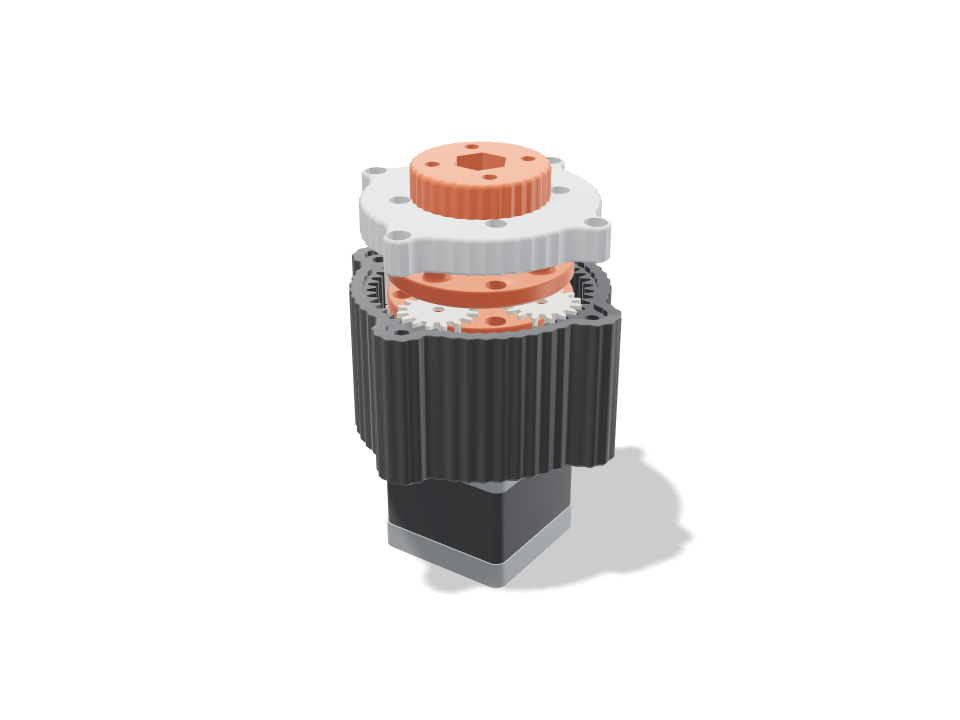
Ein zweistufiges Planetengetriebe, das direkt an einen NEMA17-Stepper geschraubt wird. Die erste Sonne wird auf die D-Welle des Motors gepresst, vier Planeten pro Stufe rollen in einem gemeinsamen Hohlrad, das in das geriffelte Gehäuse geschnitten ist, der erste Träger trägt die zweite Sonne, und der zweite Träger dreht einen Abtriebsflansch über eine M8-Schraube, die in einem 608-Lager im Deckel läuft. Drück auf Play, und die Welle dreht die Sonne, während die Planeten umlaufen und sich drehen und jeder Träger mit seiner echten untersetzten Drehzahl läuft. Die Prüfungen belegen, dass die Zahnräder in Ruhe und in jeder abgetasteten Stellung frei stehen, dass die Planeten gleichmäßig verteilt und phasenrichtig sind, dass die Zähne (Zahnfußspannung nach Lewis) und die 3-mm-Stahlstifte das Blockiermoment des Motors von 0,4 N m durch die 16:1-Untersetzung halten (etwa 5,4 N m am Abtrieb) und dass jedes Teil einen freien Weg hinein hat. Es ist ein Bausatz: gedruckte Teile plus Stifte, ein Lager und ein paar Schrauben.
Ask for the sizes you want to tweak, e.g. “make the width adjustable”.
Daten bei Standardgröße
Gemessen am echten Build auf einem Bambu Lab A1 in pla. Jede Zahl aktualisiert sich live, wenn du oben an einem Regler ziehst.
- Gesamtgröße
- 88 × 88 × 67 mm
- Teile
- 14
- Filament
- 100 g
- Druckzeit
- 3 h 23 min
- Druckplatten
- 1
- Stützstrukturen
- Nicht nötig
Technische Prüfungen
Namen von Prüfungen und Parametern kommen direkt aus der CAD-Engine und sind auf Englisch.
- Every part stands free at resttotal overlap 0.000 mm³ between gears, carriers, housing and cap with a 0.15 mm flank gap and 0.4 mm axial gaps
- Planets space evenly(16 + 48) / 4 = 16, a whole number, so all four planets mesh in phase
- Planets clear each other5.8 mm between neighbouring planet tips
- No tooth undercutsun/planet 1.00:1 needs 13+ teeth at 20 deg; smallest here 16
- Teeth overlap in meshcontact ratio 1.35 sun-planet, 1.51 planet-ring after the flank gaps (1.2+ runs smoothly)
- Stage 1 teeth take the stall torque5.0 MPa at the tooth root (Lewis, Y 0.296, 8 mm face) with 0.40 N m on its sun shared by 3 of 4 planets; PLA allows 16.7 along the layers
- Stage 1 planet pins hold27 N per pin: 44 MPa bending in the 3 mm hardened dowel (allow 500), 1.1 MPa in the planet bore (keep under ~6), 11.2 MPa in the 5 mm carrier socket vs 16.7
- Stage 2 teeth take the stall torque13.6 MPa at the tooth root (Lewis, Y 0.296, 10 mm face) with 1.47 N m on its sun shared by 3 of 4 planets; PLA allows 16.7 along the layers
- Stage 2 planet pins hold98 N per pin: 200 MPa bending in the 3 mm hardened dowel (allow 500), 3.3 MPa in the planet bore (keep under ~6), 13.9 MPa in the 10 mm carrier socket vs 16.7
- Sun grips the D-shaft6.9 MPa on 9.7 mm of the shaft flat at 0.4 N m vs 16.7; the bore prints ~0.1 mm small for a press fit
- Motor shaft clears all but its sunshaft tip at 24 mm runs in carrier 1's bushing; overlap 0.00 mm³, sun bore 0.01
- Housing bolts to the motorseats on the 22 mm boss; M3x8 bites 4.5 mm into the motor's threads; 62 N per screw from the 5.4 N m reaction, 5.2 MPa on the floor vs 16.7
- Output bolt carries the torque5.4 N m out: 102 MPa shear in the M8 core (8.8 bolt, allow 190); hex pockets 7.0 / 4.6 MPa vs 16.7
- 608 is seated and capturedflush in a 7 mm pocket on a 3.00 mm lip under the outer race; the inner race is clamped between 8 x 12 mm speed rings by the carrier shoulder and the flange, which runs 1.0 mm clear of the cap; overlap -0.00 mm³
- Cap centres on the housingthe cap sits 1.5 mm deep in the housing's bezel with 0.15 mm all round, so the bearing lands on the ring's axis; flat on the ring top; M3x12 into heat-set inserts in the lobes, 1.2 mm of cap round each screw head
- Ring wall4.2 mm under the flutes, 2.3 mm between each insert and the ring's tooth roots, 3.4 mm bezel rim standing outside the tooth roots
- Bolt and nut fitM8 x 30: the nyloc sits 5.9 mm above the flange underside, its top flush with the bolt end; the carrier shoulder passes the 8 mm lip hole with 0.5 mm all round
- Ratio16.00:1 (2 x 4.00, 16/16/48 teeth, module 1.25): 4.0 motor turns = 0.25 output turns; about 5.4 N m out from 0.4 N m at 92% per stage
- NEMA17 stepper goes in23 poses along its path clear of every part.
- NEMA17 end caps goes in23 poses along its path clear of every part.
- 608 bearing (in the cap) goes in6 poses along its path clear of every part.
- 2x M8 speed ring 8 x 12 x 1 goes in15 poses along its path clear of every part.
- M8 x 30 hex bolt goes in13 poses along its path clear of every part.
- M8 nyloc nut (in the flange) goes in15 poses along its path clear of every part.
- 3 mm steel pins, stage 1 goes in10 poses along its path clear of every part.
- 3 mm steel pins, stage 2 goes in10 poses along its path clear of every part.
- 4x M3x8 into the motor goes in15 poses along its path clear of every part.
- 4x M3x12 cap screws goes in15 poses along its path clear of every part.
- driver: motor screws (through the tool holes) goes in20 poses along its path clear of every part.
- driver: cap screws goes in20 poses along its path clear of every part.
Anpassbare Maße
| Einstellung | Standard | Bereich |
|---|---|---|
| Tooth size (module) | 1.25 mm | 1.25–1.75 mm |
| Sun teeth | 16 | 14–20 |
| Planet teeth | 16 | 14–22 |
| Stages | 2 | 1–2 |
| Gear gap (each flank) | 0.15 mm | 0.1–0.25 mm |
Teileliste
| Teil | Anz. | Größe (mm) | Filament | Zeit |
|---|---|---|---|---|
| housing | 1 | 88 × 88 × 44 | 45 g | 1 h 6 min |
| sun 1 | 1 | 22 × 22 × 13 | 2 g | 8 min |
| planet 1-1 | 1 | 22 × 22 × 8 | 2 g | 7 min |
| planet 1-2 | 1 | 22 × 22 × 8 | 2 g | 7 min |
| planet 1-3 | 1 | 22 × 22 × 8 | 2 g | 7 min |
| planet 1-4 | 1 | 22 × 22 × 8 | 2 g | 7 min |
| planet 2-1 | 1 | 22 × 22 × 10 | 2 g | 8 min |
| planet 2-2 | 1 | 22 × 22 × 10 | 2 g | 8 min |
| planet 2-3 | 1 | 22 × 22 × 10 | 2 g | 8 min |
| planet 2-4 | 1 | 22 × 22 × 10 | 2 g | 8 min |
| carrier 1 | 1 | 52 × 52 × 15 | 8 g | 16 min |
| output carrier | 1 | 52 × 52 × 13 | 8 g | 15 min |
| cap | 1 | 80 × 80 × 10 | 15 g | 24 min |
| output flange | 1 | 38 × 38 × 14 | 7 g | 14 min |
So wird’s gemacht
- Wähl Zahngröße, Zähne von Sonne und Planeten und eine oder zwei Stufen; Übersetzung und Abtriebsmoment aktualisieren sich in den Prüfungen.
- Druck Gehäuse, Träger und Planeten mit der flachen Seite nach unten, die Sonne mit den Zähnen nach unten und Deckel und Flansch mit der flachen Seite nach unten. Keine Stützen.
- Drück M3-Gewindeeinsätze in die Gehäuseaugen, schraub es mit 4x M3x8 an den Motor, drück die Sonne auf die Welle und setz dann Stufe für Stufe die Planeten auf ihren eingepressten 3-mm-Stiften ein.
- Schieb die M8-Schraube von unten durch den Abtriebsträger, leg eine Passscheibe auf, setz den Deckel mit dem 608 in der Fassung auf, schraub ihn fest und dreh dann den Flansch mit seiner Stoppmutter auf die Schraube.
Drucktipps
- PLA reicht für die gezeigten Prüfungen; Zahnräder aus PETG oder PA-CF halten unter Dauerlast länger. Druck Zahnräder mit 3–4 Wänden, damit die Zähne massiv sind.
- Wenn die Zahnräder klemmen, erhöh das Zahnspiel um 0,02 mm; wenn sie klappern, senk es. Ein Tropfen trockenes PTFE-Schmiermittel auf den Stiften hilft.
- Die Stiftprüfung geht von gehärteten 3-mm-Zylinderstiften (ISO 8734) aus; gekürzte Nägel oder weicher Draht verbiegen sich.
Häufige Fragen
Welche Hardware brauche ich?
Einen NEMA17-Stepper, 3-mm-Zylinderstifte aus Stahl (vier pro Stufe), ein 608-Lager, zwei Passscheiben 8 × 12 × 1 mm, eine M8-Sechskantschraube mit Stoppmutter, 4x M3x8- und 4x M3x12-Schrauben sowie 4 + 4 M3-Gewindeeinsätze für Deckel und Abtriebsflansch.
Wie viel Drehmoment gibt es wirklich?
Mit dem Standard-16:1 und einem 0,4-N-m-Motor liegt die Schätzung bei etwa 5,4 N m am Flansch, bei angenommenen 92 % pro gedruckter Stufe. Das ist eine Rechnung, keine Messung, also teste es auf der Werkbank, bevor du etwas Schweres daran hängst.
Kann ich eine einstufige Version machen?
Ja. Stell die Stufen auf 1 für ein kürzeres 4:1-Getriebe mit demselben Flansch und Lager. Die Bewegung läuft dann als saubere Schleife, weil jedes Teil nach vier Motorumdrehungen wieder dort ist, wo es angefangen hat.
Du brauchst eine Form, die nicht im Katalog ist? Beschreib sie in deinen eigenen Worten mit Text zu CAD
Comments