Reductora planetaria NEMA17
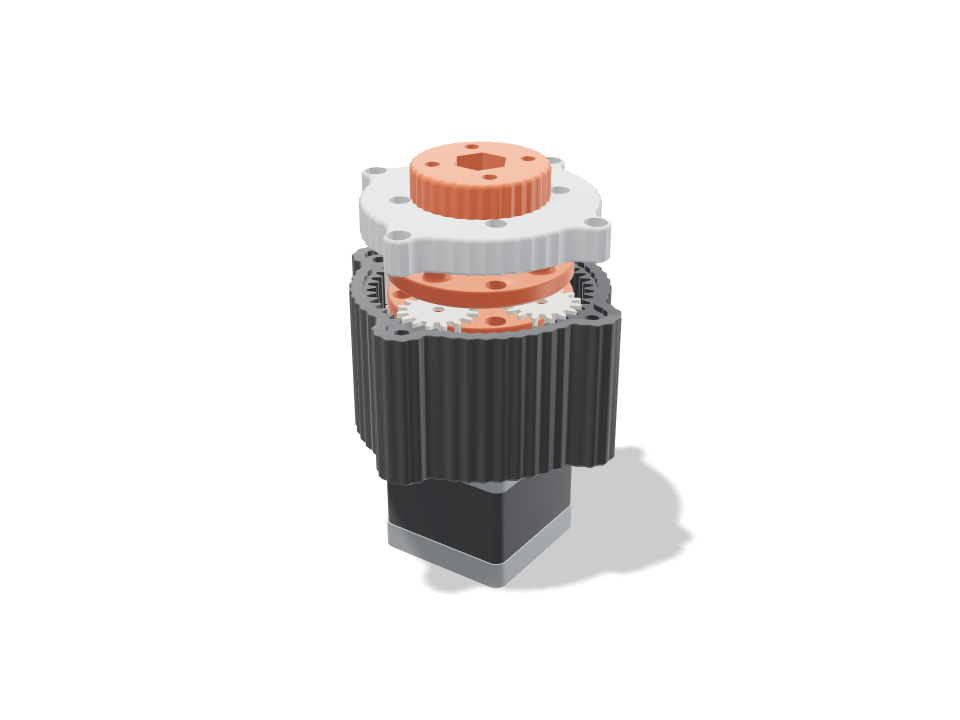
Una reductora planetaria de dos etapas que se atornilla directamente a un motor paso a paso NEMA17. El primer sol entra a presión en el eje en D del motor, cuatro planetas por etapa ruedan alrededor de una corona compartida tallada en la carcasa acanalada, el primer portasatélites lleva el segundo sol, y el segundo portasatélites gira una brida de salida mediante un perno M8 que va en un rodamiento 608 en la tapa. Dale a reproducir y el eje gira el sol mientras los planetas orbitan y giran y cada portasatélites gira a su velocidad reducida real. Las revisiones demuestran que los engranajes quedan libres en reposo y en cada posición muestreada, que los planetas están repartidos y en fase por igual, que los dientes (tensión en la raíz de Lewis) y los pasadores de acero de 3 mm aguantan el par de bloqueo de 0,4 N m del motor a través de la reducción 16:1 (unos 5,4 N m a la salida), y que cada pieza tiene un camino libre para entrar. Es un kit: piezas impresas más pasadores, un rodamiento y unos pocos tornillos.
Ask for the sizes you want to tweak, e.g. “make the width adjustable”.
Especificaciones con el tamaño por defecto
Medido en la construcción real en una Bambu Lab A1 con pla. Cada número se actualiza al momento cuando mueves un deslizador de arriba.
- Tamaño total
- 88 × 88 × 67 mm
- Piezas
- 14
- Filamento
- 100 g
- Tiempo de impresión
- 3 h 23 min
- Placas
- 1
- Soportes
- No hacen falta
Revisiones de ingeniería
Los nombres de las revisiones y de los parámetros vienen del motor de CAD y se muestran en inglés.
- Every part stands free at resttotal overlap 0.000 mm³ between gears, carriers, housing and cap with a 0.15 mm flank gap and 0.4 mm axial gaps
- Planets space evenly(16 + 48) / 4 = 16, a whole number, so all four planets mesh in phase
- Planets clear each other5.8 mm between neighbouring planet tips
- No tooth undercutsun/planet 1.00:1 needs 13+ teeth at 20 deg; smallest here 16
- Teeth overlap in meshcontact ratio 1.35 sun-planet, 1.51 planet-ring after the flank gaps (1.2+ runs smoothly)
- Stage 1 teeth take the stall torque5.0 MPa at the tooth root (Lewis, Y 0.296, 8 mm face) with 0.40 N m on its sun shared by 3 of 4 planets; PLA allows 16.7 along the layers
- Stage 1 planet pins hold27 N per pin: 44 MPa bending in the 3 mm hardened dowel (allow 500), 1.1 MPa in the planet bore (keep under ~6), 11.2 MPa in the 5 mm carrier socket vs 16.7
- Stage 2 teeth take the stall torque13.6 MPa at the tooth root (Lewis, Y 0.296, 10 mm face) with 1.47 N m on its sun shared by 3 of 4 planets; PLA allows 16.7 along the layers
- Stage 2 planet pins hold98 N per pin: 200 MPa bending in the 3 mm hardened dowel (allow 500), 3.3 MPa in the planet bore (keep under ~6), 13.9 MPa in the 10 mm carrier socket vs 16.7
- Sun grips the D-shaft6.9 MPa on 9.7 mm of the shaft flat at 0.4 N m vs 16.7; the bore prints ~0.1 mm small for a press fit
- Motor shaft clears all but its sunshaft tip at 24 mm runs in carrier 1's bushing; overlap 0.00 mm³, sun bore 0.01
- Housing bolts to the motorseats on the 22 mm boss; M3x8 bites 4.5 mm into the motor's threads; 62 N per screw from the 5.4 N m reaction, 5.2 MPa on the floor vs 16.7
- Output bolt carries the torque5.4 N m out: 102 MPa shear in the M8 core (8.8 bolt, allow 190); hex pockets 7.0 / 4.6 MPa vs 16.7
- 608 is seated and capturedflush in a 7 mm pocket on a 3.00 mm lip under the outer race; the inner race is clamped between 8 x 12 mm speed rings by the carrier shoulder and the flange, which runs 1.0 mm clear of the cap; overlap -0.00 mm³
- Cap centres on the housingthe cap sits 1.5 mm deep in the housing's bezel with 0.15 mm all round, so the bearing lands on the ring's axis; flat on the ring top; M3x12 into heat-set inserts in the lobes, 1.2 mm of cap round each screw head
- Ring wall4.2 mm under the flutes, 2.3 mm between each insert and the ring's tooth roots, 3.4 mm bezel rim standing outside the tooth roots
- Bolt and nut fitM8 x 30: the nyloc sits 5.9 mm above the flange underside, its top flush with the bolt end; the carrier shoulder passes the 8 mm lip hole with 0.5 mm all round
- Ratio16.00:1 (2 x 4.00, 16/16/48 teeth, module 1.25): 4.0 motor turns = 0.25 output turns; about 5.4 N m out from 0.4 N m at 92% per stage
- NEMA17 stepper goes in23 poses along its path clear of every part.
- NEMA17 end caps goes in23 poses along its path clear of every part.
- 608 bearing (in the cap) goes in6 poses along its path clear of every part.
- 2x M8 speed ring 8 x 12 x 1 goes in15 poses along its path clear of every part.
- M8 x 30 hex bolt goes in13 poses along its path clear of every part.
- M8 nyloc nut (in the flange) goes in15 poses along its path clear of every part.
- 3 mm steel pins, stage 1 goes in10 poses along its path clear of every part.
- 3 mm steel pins, stage 2 goes in10 poses along its path clear of every part.
- 4x M3x8 into the motor goes in15 poses along its path clear of every part.
- 4x M3x12 cap screws goes in15 poses along its path clear of every part.
- driver: motor screws (through the tool holes) goes in20 poses along its path clear of every part.
- driver: cap screws goes in20 poses along its path clear of every part.
Medidas ajustables
| Parámetro | Por defecto | Rango |
|---|---|---|
| Tooth size (module) | 1.25 mm | 1.25–1.75 mm |
| Sun teeth | 16 | 14–20 |
| Planet teeth | 16 | 14–22 |
| Stages | 2 | 1–2 |
| Gear gap (each flank) | 0.15 mm | 0.1–0.25 mm |
Lista de piezas
| Pieza | Cant. | Tamaño (mm) | Filamento | Tiempo |
|---|---|---|---|---|
| housing | 1 | 88 × 88 × 44 | 45 g | 1 h 6 min |
| sun 1 | 1 | 22 × 22 × 13 | 2 g | 8 min |
| planet 1-1 | 1 | 22 × 22 × 8 | 2 g | 7 min |
| planet 1-2 | 1 | 22 × 22 × 8 | 2 g | 7 min |
| planet 1-3 | 1 | 22 × 22 × 8 | 2 g | 7 min |
| planet 1-4 | 1 | 22 × 22 × 8 | 2 g | 7 min |
| planet 2-1 | 1 | 22 × 22 × 10 | 2 g | 8 min |
| planet 2-2 | 1 | 22 × 22 × 10 | 2 g | 8 min |
| planet 2-3 | 1 | 22 × 22 × 10 | 2 g | 8 min |
| planet 2-4 | 1 | 22 × 22 × 10 | 2 g | 8 min |
| carrier 1 | 1 | 52 × 52 × 15 | 8 g | 16 min |
| output carrier | 1 | 52 × 52 × 13 | 8 g | 15 min |
| cap | 1 | 80 × 80 × 10 | 15 g | 24 min |
| output flange | 1 | 38 × 38 × 14 | 7 g | 14 min |
Cómo hacerlo
- Elige el tamaño de diente, los dientes del sol y de los planetas y una o dos etapas; la relación y el par de salida se actualizan en las revisiones.
- Imprime la carcasa, los portasatélites y los planetas con la cara plana abajo, el sol con los dientes abajo, y la tapa y la brida con la cara plana abajo. Sin soportes.
- Mete a presión insertos roscados M3 en los lóbulos de la carcasa, atorníllala al motor con 4x M3x8, mete el sol a presión en el eje y luego coloca los planetas sobre sus pasadores de 3 mm metidos a presión, etapa por etapa.
- Pasa el perno M8 hacia arriba por el portasatélites de salida, pon un anillo de ajuste, baja la tapa con el 608 en el bisel, atorníllala y luego enrosca la brida con su tuerca autoblocante en el perno.
Consejos de impresión
- El PLA sirve para las revisiones mostradas; los engranajes de PETG o PA-CF duran más bajo carga constante. Imprime los engranajes con 3-4 perímetros para que los dientes sean macizos.
- Si los engranajes se atascan, sube la holgura de engrane 0,02 mm; si traquetean, bájala. Una gota de lubricante PTFE seco en los pasadores ayuda.
- La revisión de los pasadores supone pasadores cilíndricos templados de 3 mm (ISO 8734); clavos cortados o varilla blanda se doblarán.
Preguntas frecuentes
¿Qué tornillería necesito?
Un motor paso a paso NEMA17, pasadores cilíndricos de acero de 3 mm (cuatro por etapa), un rodamiento 608, dos anillos de ajuste de 8 × 12 × 1 mm, un perno hexagonal M8 con tuerca autoblocante, 4x tornillos M3x8 y 4x M3x12, y 4 + 4 insertos roscados M3 para la tapa y la brida de salida.
¿Cuánto par da de verdad?
Con la 16:1 por defecto y un motor de 0,4 N m la estimación es de unos 5,4 N m en la brida, suponiendo un 92% por etapa impresa. Es un cálculo, no una medición, así que pruébala en el banco antes de colgarle algo pesado.
¿Puedo hacer una versión de una etapa?
Sí. Pon las etapas en 1 para una caja 4:1 más corta con la misma brida y rodamiento. El movimiento se repite entonces en un bucle limpio porque cada pieza vuelve a su sitio tras cuatro vueltas del motor.
¿Necesitas una forma que no esté en el catálogo? Descríbela con tus propias palabras usando el texto a CAD
Comments