Print-in-place toolbox for your 3D printing tools
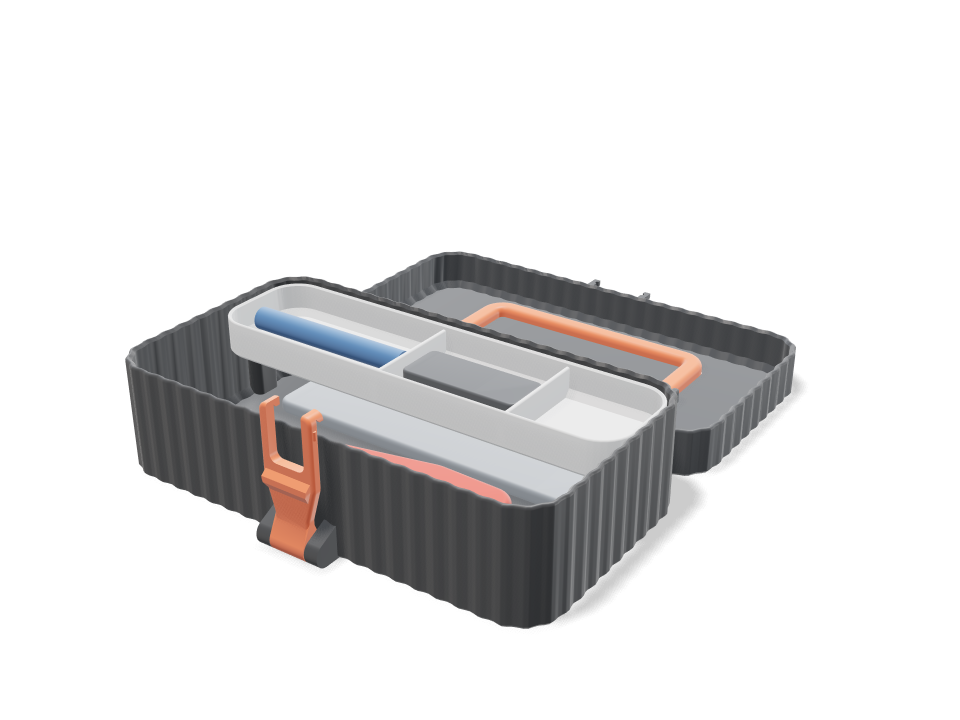
A fluted toolbox that comes off the bed already assembled: the base prints upright and the lid prints upside down behind it on a pin-in-knuckle hinge, so there is nothing to glue or screw. An orange latch flips on its own pin at the foot of the box, hooks a lug on the lid and snaps two springy tines into the lid's cheeks, and a carry handle lies flush in the lid top on its own pins and folds up for carrying. A separate lift-out tray holds nozzle needles and hex keys above flush cutters and a scraper. The checks prove every printed body stands free with a running gap, both motions (closing and latching, then lifting the handle) clear at every sampled pose, the tools fit with the lid shut, the tine snap stays under a quarter of PLA's breaking strain and the latch, hinge and handle carry the full box with a bump.
Ask for the sizes you want to tweak, e.g. “make the width adjustable”.
Specs at the default size
Measured from the actual build on a Bambu Lab A1 in pla. Every number updates live when you drag a slider above.
- Overall size
- 200 × 246 × 60 mm
- Parts
- 5
- Filament
- 225 g
- Print time
- 5 h 28 min
- Build plates
- 2
- Supports
- None needed
Engineering checks
- Printed-in-place bodies stand freetotal overlap 0.000 mm³ between base, open lid, latch and handle as printed
- Open lid lands on the bedlid outer face at z = 0.00 mm, handle flush in its slot
- Closed lid seats on the rim0.3 mm above the rim when shut; hinge and latch cheeks locate it; overlap 0.000 mm³
- Hinge knuckle wall1.90 mm around a 4.4 mm pin, 0.4 mm radial gap, 0.4 mm axial gaps
- Latch sits clear when shutoverlap 0.000 mm³ with the closed lid
- Hook holds the lid downlip land bears on the lug over 2.0 mm; lifting the lid 1 mm runs the lug into the lip (11 mm³)
- Snap tines flex safely0.75 % peak strain at 0.5 mm flex (20 mm tine, 4.0 mm wide); PLA breaks at 4 %, kept under a quarter for repeated snaps
- Snap feel24 N squeeze to pass the cheeks (both tines): a deliberate thumb push
- Latch lip carries the base0.7 MPa bending at the lip root, 7 N (half of 0.67 kg, x2 for a bump); PLA allows 16.7
- Latch pivot pin0.2 MPa shear, 0.1 MPa bearing on the 4.4 mm pin
- Hinge pin0.1 MPa shear, 0.0 MPa bearing per lid knuckle
- Handle grip carries the box5.5 MPa at mid-grip for 0.75 kg x2; printed flat so it bends along the layers; allows 16.7
- Handle pivots0.8 MPa shear, 0.5 MPa bearing on each 3.5 mm pin
- Fits: flush cuttersoverlap 0.00 mm³ with base, tray and the closed lid
- Fits: scraperoverlap 0.00 mm³ with base, tray and the closed lid
- Fits: nozzle needle caseoverlap 0.00 mm³ with base, tray and the closed lid
- Fits: hex keysoverlap 0.00 mm³ with base, tray and the closed lid
- A hand fits under the raised handle85 x 30 mm grip envelope between the arms, 31.5 mm clear under the grip, 101 mm between the arms
- Handle swings clear of the lidworst overlap 0.000 mm³ over 0-90 degrees about its pins (0.5 mm slot gap, 0.4 mm pin gap)
- Fits the A1 bed in one print200 x 246 mm printed open (256 mm bed)
- Latch detent is real and clearsswung out 30 deg it clears the closing lid; back at 6 deg the bumps just meet the cheeks (0.00 mm³); at 2.5 deg the rigid bumps overlap the cheeks by 1.6 mm³, the 0.5 mm the tines must flex to snap home
- toolbox stays together after printingall 4 bodies are captive: none can be pulled out along any axis
- toolbox is held firmlyevery captive body is held by at least 0.8 mm (two perimeters)
- flush cutters goes in40 poses along its path clear of every part.
- scraper goes in63 poses along its path clear of every part.
- nozzle needle case goes in30 poses along its path clear of every part.
- hex keys goes in30 poses along its path clear of every part.
Adjustable sizes
| Setting | Default | Range |
|---|---|---|
| Length | 200 mm | 170–240 mm |
| Depth (front to back) | 108 mm | 90–110 mm |
| Closed height | 70 mm | 56–85 mm |
| Hinge radial gap | 0.4 mm | 0.3–0.6 mm |
| Wall | 2.4 mm | 1.8–3.2 mm |
| Lift-out tray | on | on / off |
Parts list
| Part | Qty | Size (mm) | Filament | Time |
|---|---|---|---|---|
| base | 1 | 200 × 129 × 49 | 109 g | 2 h 30 min |
| lid | 1 | 200 × 126 × 40 | 72 g | 1 h 41 min |
| latch | 1 | 26 × 11 × 60 | 3 g | 14 min |
| handle | 1 | 119 × 49 × 8 | 7 g | 14 min |
| tray | 1 | 192 × 49 × 16 | 33 g | 49 min |
How to make it
- Set the length, depth and height to your tool kit; the defaults hold 125 mm flush cutters, a 150 mm scraper, a needle case and a hex key set.
- Print the box as one object exactly as laid out (base upright, lid face down behind it), PLA or PETG, no supports. Print the tray separately.
- Snap it free: turn the lid and latch gently by hand until they move easily, then lift the handle out of its slot.
- Close the lid, swing the latch up and push its top in until the tines click into the cheeks; lift the handle to carry.
Print tips
- Print the hinge gap test first if your printer runs hot or the first layer squishes: raise Hinge radial gap to 0.5 mm if the parts fuse.
- Turn off elephant-foot compensation tricks that merge layers near the bed; the latch knuckle and handle start on the first layer.
- PETG gives the latch tines more snap life than PLA; PLA works for occasional use.
FAQ
Do I need any screws or glue?
No. The hinge, latch and handle all print on their own pins, already assembled. Only the tray is a separate piece, and it just drops in.
Will the latch hold if I carry it by the handle?
The base hangs from the hinge and the latch lip when you carry it; the checks give large margins for about 0.7 kg with a bump. The click of the tines is a feel detent that keeps the latch shut, so test it once with your tools inside.
What if the lid or latch is stuck after printing?
Work it slowly back and forth. If it stays fused, reprint with a slightly bigger hinge gap; every gap scales from that slider.
Need a shape that isn't in the catalog? Describe it in your own words with text to CAD
Comments