Print-in-place planetary gear bearing generator
Six bodies print as one object, already meshed, and turn the moment they come off the plate. Herringbone teeth lock the sun, planets and ring together along the axis, so there is no carrier, pin or screw. The teeth are true 20° involutes. The planets are spaced so the tooth counts divide evenly, and the script solves each planet's starting phase. The sun and planet counts are checked against the textbook minimum for interference, and Lewis root stress is checked for a firm hand twist. The use animation turns the sun four times, which carries the planets once around the ring and back to exactly where they started, so the loop never jumps. Offline verification checks every body for collisions at all 481 sampled poses of that loop.
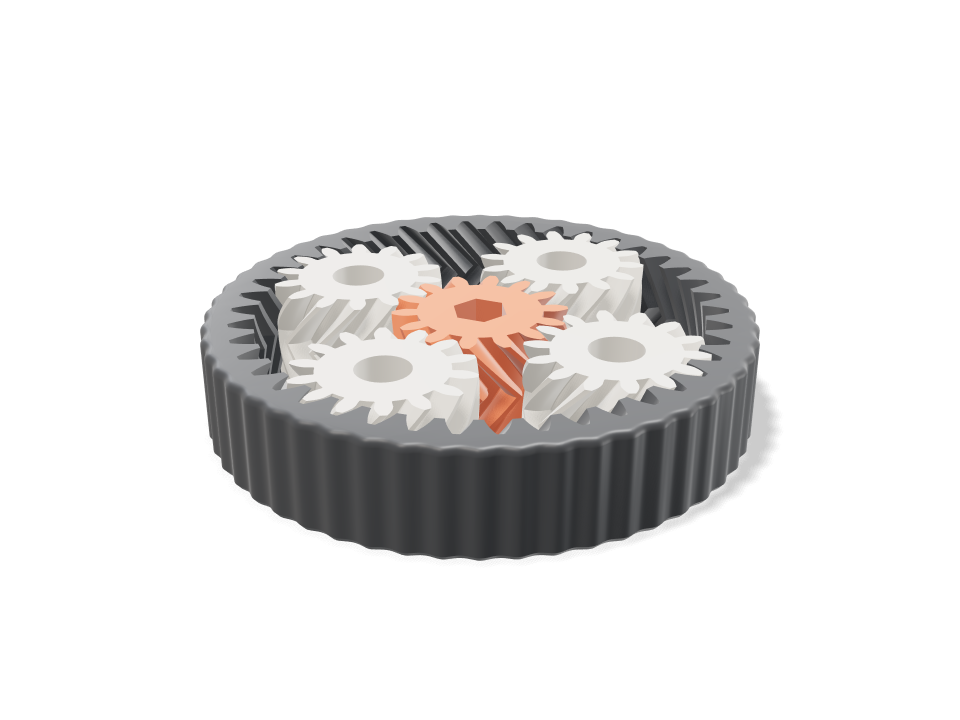
Ask for the sizes you want to tweak, e.g. “make the width adjustable”.
Specs at the default size
Measured from the actual build on a Bambu Lab A1 in PLA. Every number updates live when you drag a slider above.
- Overall size
- 74 × 74 × 15 mm
- Parts
- 6
- Filament
- 32 g
- Print time
- 1 h 14 min
- Build plates
- 1
- Supports
- None needed
Engineering checks
- Every body stands free at resttotal overlap 0.000 mm³ with a 0.12 mm flank gap per side
- Planets space evenly(14 + 42) / 4 = 14, a whole number, so every planet meshes in phase
- Planets clear each other5.7 mm between neighbouring tooth tips
- Herringbone captures the bodies axiallya planet lifts 0.30 mm before its teeth bind; 0.3 mm more hits its mates (15 mm³)
- Snug running fit0.30 mm axial float, 0.35 mm radial wobble per planet at a 0.12 mm flank gap: tight enough not to rattle or pry out; open the gap 0.01 mm at a time if it binds
- Ratiosun to carrier 4.00:1 with the ring held; 14/14/42 teeth, module 1.5
- No tooth interferencesun/planet mesh at 1.00:1 needs 13+ teeth at 20 deg; smallest here 14
- Teeth take a firm hand twist2.5 MPa at the tooth root for 0.5 N m on the sun (Lewis, Y 0.277); PLA allows 16.7
Adjustable sizes
| Setting | Default | Range |
|---|---|---|
| Tooth size (module) | 1.5 mm | 1.2–2.5 mm |
| Sun teeth | 14 | 10–20 |
| Planet teeth | 14 | 10–20 |
| Height | 15 mm | 10–25 mm |
| Flank gap (each side) | 0.12 mm | 0.08–0.3 mm |
| Helix angle | 40 deg | 15–45 deg |
Parts list
| Part | Qty | Size (mm) | Filament | Time |
|---|---|---|---|---|
| ring | 1 | 74 × 74 × 15 | 14 g | 23 min |
| sun | 1 | 24 × 24 × 15 | 4 g | 10 min |
| planet 1 | 1 | 24 × 24 × 15 | 4 g | 10 min |
| planet 2 | 1 | 24 × 24 × 15 | 4 g | 10 min |
| planet 3 | 1 | 24 × 24 × 15 | 4 g | 10 min |
| planet 4 | 1 | 24 × 24 × 15 | 4 g | 10 min |
How to make it
- Start at the default 0.12 mm flank gap on a well-tuned printer: snug enough that the planets cannot be pried out. If yours fuses or binds, raise it 0.01 mm at a time.
- Pick a module: bigger teeth are stronger and more forgiving, smaller ones turn more smoothly.
- Watch the checks: even planet spacing, tooth interference and tooth-root stress re-run as you drag.
- Print it flat as one object, then twist the ring against the sun with a 1/4 inch hex bit to break it free.
Print tips
- 0.2 mm layers or finer, slow outer walls, and no elephant's foot: the first layer is where gears fuse.
- PLA or PETG. The herringbone flanks print without supports because each half leans less than 45°.
FAQ
Will it really turn straight off the printer?
The model is checked free at rest and, offline, at every sampled pose of the planets' full orbit. Whether your print breaks free depends on your printer's clearance, so print one at the default gap before you scale it up or tighten it.
Why herringbone teeth?
The two opposed helices hold every body in place along the axis. That is what lets a planetary print in place without a carrier plate or any hardware.
What is the gear ratio?
With the ring held, the carrier turns once for every 1 + ring/sun turns of the sun: 4:1 at the default 14/14/42 teeth. The checks report it for your counts.
Comments