Mason jar thread size and pitch: how to print a lid that screws on
Mason jar threads are coarse, short and badly documented: sources quote pitches from 4.23 to 6.5 mm, and a lid cut at the wrong one won’t screw down. Here is where each number comes from, how to measure your jar, and a clearance checked in the Loftsmith engine.
Short answer
Regular-mouth mason jars (finish 70-450) have a thread about 70 mm across; wide-mouth jars about 86 mm. The thread is coarse and short: makers report 6–6.5 mm per turn on wide-mouth jars, and a closure maker’s 70-450 drawing, as search engines index it, lists 6.35 mm (4 threads per inch). The often-quoted 4.23 mm (6 TPI) is the GPI 400-series figure. Measure your jar, start at 0.4 mm radial clearance, and print the 6 g fit ring before the lid.
Look up a mason jar’s thread pitch and you get at least three answers: 4.23 mm, “just about 6 mm” and 6.5 mm. Print a lid at the wrong one and it starts, turns part of the way and locks. More clearance doesn’t fix that, because the problem isn’t the fit. The 4.23 mm figure comes from the table for a different 70 mm finish (the 400 series). The other two are a measurement and a model value for wide-mouth jars, and both sit close to the 6.35 mm on a 70-450 cap drawing (as search engines index it).
This guide gives the jar sizes with their sources, explains where each pitch comes from, shows how to measure your own jar, and gives a starting clearance checked in the Loftsmith engine on a mason jar lantern lid. None of it has been printed yet. Where a number is ours, the text says so.
Regular vs wide mouth: the numbers you need
Mason jars come in two mouths, regular and wide. Beyond that, sources disagree on more than you’d expect, so the table keeps the disagreements in and says who measured what, and which figures are design choices in someone’s model rather than measurements.
| Regular mouth | Wide mouth | |
|---|---|---|
| Thread diameter, nominal | about 70 mm (2.75 in) | about 86 mm (3.38 in) |
| Thread diameter, measured | no measurement found | 86.3 mm (HSM forum) |
| Thread diameter, used in a shared model | none found | 82 mm (jpoles1’s wide-mouth thread) |
| Inside opening | 2-3/8 in (60.3 mm) | 3 in (76.2 mm) |
| Finish code | 70-450 (also written 70G-450) | sold as 86-450 or 86-460; one page says 86-400 (see below) |
| Turns of thread | 1¼ on a 70-450 cap drawing (as indexed); 1.5–2 in Cary’s lid chart | about 1.1 (HSM forum) |
| Pitch | 6.35 mm (4 TPI) on a 70-450 cap drawing (as indexed) | about 6 mm measured (HSM forum); 6.5 mm used in jpoles1’s model |
| Mouth to neck ring | no measurement found | 16 mm (HSM forum) |
The wide-mouth code is used loosely
Suppliers don’t agree on the wide-mouth code. tpglassbottle’s specification guide and Wells Can sell the lid as 86-450, and Fillmore Container says Ball and Kerr wide-mouth jars take an 86-460 lid. A second tpglassbottle page lists 86-400, which conflicts with its own other page. Given how 400 and 450 differ at 70 mm (next), read that 86-400 as a mislabel. Don’t buy a generic 86-400 closure and expect it to fit a canning jar; buy one listed for wide-mouth canning jars, the way Fillmore lists its 86-460 lid for Ball wide mouth.
70-400 is not 70-450
Both are 70 mm, and that catches people out. Fillmore Container describes 70-400 as a short-skirted continuous-thread finish that isn’t interchangeable with 70-450, and Cincinnati Container describes the 70G-450 cap as deep-skirted, with a canning look. The suppliers stop there. Our reading of the pitch sources in the next section (US Plastic’s 400-series table and Comet’s 450 drawing) is that the threads differ too: 6 TPI for the 400 finish, 4 TPI for the standard 450.
These numbers are for Ball and Kerr style home-canning jars. Decorative jars sold as “mason jars” may use other finishes, which is one more reason to measure the jar on your bench. The lantern lid we checked uses a 60.3 mm mouth for its pocket, which is NCHFP’s 2-3/8 in.
Why sources disagree on the pitch
The short version: 4.23 mm is a real figure, but it belongs to a different finish.
- 4.23 mm (6 TPI) comes from the 400-series table. US Plastic’s cap and neck sizing article, a commonly copied GPI table, lists 6 threads per inch for a 70 mm finish. Its dimension table has columns for the 400, 410 and 415 finishes only, and never mentions 450. Regular mason jars are 70-450.
- A 70-450 continuous-thread cap drawing, as indexed, gives 6.35 mm (4 TPI). Search engines index Comet Tool’s drawing 1340-0109, “70-450 Continuous Threads”, as listing a 0.250 in pitch (4 TPI) and 1¼ turns of thread. It is an image PDF and we haven’t read the sheet itself. A search snippet also says one of Comet’s two 70-450 sheets is marked as an advertising drawing, not for quality control, and we don’t know which one.
- A 6 TPI 450 cap exists, as a special. Comet’s other 70-450 drawing (1340-0029) is indexed as a special interrupted-thread closure, at 0.167 in pitch (6 TPI) with 1.2 turns. So a 6 TPI 450 cap is possible, but it isn’t the standard continuous thread.
- Makers report 6–6.5 mm. On the Home Shop Machinist forum, a maker measured a wide-mouth jar at “just about 6 mm” crest to crest, over about 1.1 turns. jpoles1’s wide-mouth thread model (Thingiverse, Printables) uses 6.5 mm (“6–7 mm”): a design value, not a reported measurement. A woodworker on the Vectric forum cut a wooden lid at 4 TPI.
| TPI | Pitch | Where you’ll see it |
|---|---|---|
| 4 | 6.35 mm | 70-450 continuous-thread cap drawing (as indexed); a wooden lid on the Vectric forum |
| 6 | 4.23 mm | GPI 400-series table; Comet’s special interrupted 70-450 cap |
Our reading: the maker reports and the drawing as indexed agree on about 6–6.5 mm, and 4.23 mm is the 400-series value. Three gaps keep that from being settled: we haven’t read the Comet sheet ourselves, we found no closure drawing for the 86 mm finish, and we found no published measurement of a regular-mouth jar. So measure yours.
Why more clearance can’t rescue the wrong pitch
A thread cut at the wrong pitch falls out of step with the jar by the difference in pitch on every turn. Here is the arithmetic (ours) for a lid cut at 4.23 mm on a jar at 6.35 mm, over the 1.25 turns the engine’s check unscrews the lid:
drift = (6.35 − 4.23) mm per turn × 1.25 turns = 2.65 mm
The same HSM post puts the gap between the glass ridges at about 2.6 mm. So by the end of the thread, the lid’s ridge sits where the glass ridge is: a whole groove out of step. Clearance can’t absorb that. A lid loose enough to slide a full groove along the jar would have nothing left holding it on. Get the pitch right first; clearance only tunes the feel.
The lantern lid’s default, and what to set
The lantern lid’s pitch slider defaults to 4.23 mm, the 400-series value. Treat it as a placeholder, not a claim about your jar: the evidence above points to about 6.35 mm. Set the slider (it runs 4.2–6.5 mm) to the pitch you measure. Both ends of that range build with all 16 checks passing, and so does the wide 86 mm mouth, each built one at a time from the defaults.
Be clear about what that proves. The engine models the jar thread from the slider values, not from a scan of a real jar. A pass at a given pitch shows the lid fits a jar with that pitch, not that your jar has it.
How to measure your jar’s pitch
Pitch is how far the thread climbs in one turn, measured along the jar’s axis. A mason jar thread runs only a little more than one turn, so there is just one short stretch where the thread overlaps itself. That is the only place to measure it.
- Turn the jar until you find where the start of the thread and its end sit one above the other.
- Measure from the crest of the upper ridge to the crest of the lower one, straight up and down, parallel to the jar’s axis. Calipers are easiest; a steel rule held square to the glass also works. This is how the HSM poster got “just about 6 mm”.
- If the overlap is long enough, measure at two points along it and average them.
- Measure the diameter across the ridges too, with the calipers’ outside jaws. It confirms which mouth you have. For wide mouth, compare it with the 86.3 mm measured on the HSM forum (jpoles1’s model uses 82 mm).
Then match the reading to the TPI table above. If it falls between about 6.0 and 6.6 mm, set 6.35 mm: one caliper reading across rounded glass ridges can’t split a few tenths of a millimetre, and 6.35 mm is where the drawing and the maker reports cluster. Let the fit ring decide. If your reading is far from that, near 4.23 mm or somewhere else, use your own number and print the ring before trusting it.
How much clearance a printed jar thread needs
Start at 0.4 mm of radial clearance: the gap, per side, between the lid’s thread and the glass. That is the lantern lid’s default. In the Loftsmith engine, at the default 4.23 mm pitch, it checks out like this:
- Thread clearance: jar thread 70 mm OD modelled at 4.23 mm pitch; lid ridge reaches 0.95 mm into the glass groove, 0.4 mm radial clearance.
- Unscrewing: jar thread sampled every 90 degrees for 1.25 turns off the lid; 0.95 mm radial engagement (0.6 mm minimum).
In plain terms: the check turns the lid off the jar along the helix, looks at the thread every 90 degrees, and asks for at least 0.6 mm of radial overlap between the lid’s ridge and the glass groove. At 4.23 mm pitch it has 0.95 mm.
That figure is for the default pitch, not the 6.35 mm this guide recommends trying first. The build at the 6.5 mm end of the pitch slider passes the same checks, so the engagement there is at least the 0.6 mm minimum, but the report doesn’t give the exact figure, and we haven’t built it at exactly 6.35 mm.
The clearance slider runs from 0.3 to 0.7 mm, and both ends build with every check passing. Use it to tune the feel once the pitch is right: go up if the ring binds and you are sure of the pitch, down if it goes on but rocks.
Why is that looser than a plastic thread? Because glass doesn’t give, and one lid has to fit more than one jar. For plastic on plastic, the guide to designing printed threads that fit starts at 0.1–0.2 mm per side between the flanks. On top of that, a lid’s thread is a large printed hole, and printed holes come out small (the tolerance guide explains why printed holes shrink). Two outside figures for comparison, measured differently from ours: Kapy CAD suggests 0.3–0.4 mm of total flank clearance on mason jar threads, and the HSM poster modelled an 87 mm lid over the 86.3 mm jar, about 0.35 mm per side, and called it deliberately sloppy.
Print the fit ring first
The lantern lid comes with a fit ring: just the threaded collar, cut with the same thread as the lid. It is 76.4 × 76.4 × 9.5 mm, about 6 g and 12 minutes, with no supports and 0.0% overhang in the engine’s build. The lid alone is about 20 g and 32 minutes. Screw the ring onto your jar and read the result:
| What the ring does | What it means | What to change |
|---|---|---|
| Spins down to the end of the thread and sits with little rock | Pitch and clearance suit this jar | Nothing. Print the lid with the same settings |
| Starts, then tightens and stops well before the end of the thread | The pitch is off | Measure the pitch again and set the slider to it |
| Won’t start at all | Wrong mouth setting, or too little clearance | Check the mouth setting, then raise the clearance |
| Goes on but rocks, or jumps the thread when you push it sideways | Too much clearance | Lower the clearance |
When the ring is right, switch it off and print the lid and handle with the same pitch, clearance and filament. If you change spools, print the ring again: a different filament can move a fit.
You can open the mason jar lantern lid in Loftsmith. It opens at the 4.23 mm default pitch, so set the mouth, the pitch you measured and the clearance first, and print the ring before anything else.
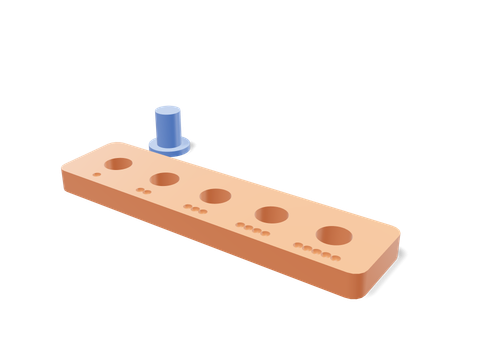 Tolerance testerA ladder of holes and pegs that shows how much your printer closes up a hole, before you trust any clearance.71 × 35 × 10 mm · 5 g · 21 min
Skirt depth and printing without supports
A jar lid has to stop on its thread, not on the glass below it. Under the thread, a mason jar has a raised bead (the neck ring), and a skirt that is too deep lands on it before the thread pulls tight. In the engine, the lantern lid’s skirt reaches 11.4 mm below the lip and the shoulder bead starts about 16 mm down, which leaves 4.6 mm. The model uses 16 mm, the HSM wide-mouth figure; we found none for the regular mouth. If you design a deeper lid of your own, measure that distance on your jar first.
All three parts print without supports. The engine flags 0.7% overhang on the lid, 0.2% on the handle and 0.0% on the fit ring (the guide to overhangs and bridges explains what that number means for supports).
| Walls / infill | Filament | Time |
|---|---|---|
| 2 walls / 15% | about 35 g | about 1 h 1 min |
| 3 walls / 15% | about 47 g | about 1 h 22 min |
| 3 walls / 20% | about 48 g | about 1 h 22 min |
| 4 walls / 20% | about 51 g | about 1 h 28 min |
| 4 walls / 25% | about 51 g | about 1 h 29 min |
The model’s listing quotes 2 walls and 15%. The threads guide suggests three to five perimeters so the teeth are solid plastic; here, going from 2 to 3 walls costs 12 g and 21 minutes for the whole set.
The print-in-place swing handle, briefly
The lantern carries its jar on a bail handle printed in place on two captive 5 mm pins, with a 0.35 mm radial gap (the hinge-gap slider runs 0.25–0.6 mm). End caps and ears stop it sliding more than 0.45 mm either way. It swings 180 degrees clear, through 13 sampled poses in the check and 37 in the motion sweep, and leaves 55 mm between the lid top and the grip for a hand.
| Where | Stress | PETG allows |
|---|---|---|
| Each pin, bending | 5.0 MPa | 15 MPa (along the layers) |
| Each pin, shear | 1.0 MPa | 5 MPa (across the layers) |
| Bail arch, slimmest 7 × 8.4 mm section | 9.7 MPa (conservative) | 15 MPa |
| Ear root | 0.8 MPa | not stated in the check |
| Thread ridge, shear, half engaged (at 4.23 mm pitch) | 0.08 MPa | 5 MPa (across the layers) |
These are checks on the geometry, not a load or drop test. The guide to how much weight printed parts hold shows the arithmetic behind checks like these, and the print-in-place hinge guide covers why a printed pin needs more gap than a normal fit.
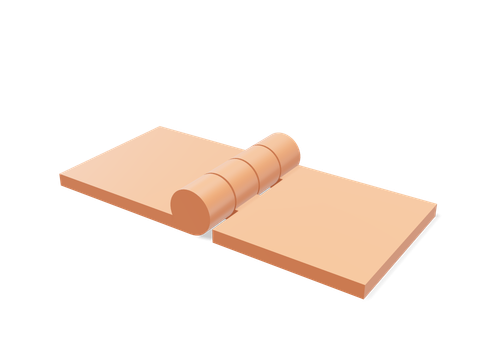 Print-in-place hinge testerA small print-in-place hinge to find the pin gap your printer frees reliably.61 × 28 × 8 mm · 5 g · 11 min
What a printed jar lid is not for
- Not for canning. Home canning guidance (NCHFP, from the USDA Complete Guide) recommends mason jars with self-sealing lids: a flat metal lid with a sealing compound, held down by a screw band. Penn State Extension calls the two-piece lid the standard. A printed lid has no seal, and we ran no seal or heat check.
- Dry goods and decoration only. At the default pitch, the thread carries the jar with room to spare (0.08 MPa of shear in the ridge against 5 MPa allowed), but carrying isn’t sealing. Don’t count on it to keep air or moisture out.
- LED tea lights only. Never a flame under a plastic lid. Carry the lantern or stand it on a table; don’t hang it above head height or over a path.
- PETG rather than PLA. Loftsmith’s material profiles put PETG’s heat deflection at 70 °C against 55 °C for PLA, which is margin worth having on a porch in the sun. The PLA vs PETG vs ASA comparison covers outdoor use.
How we checked this
Written and checked by the Loftsmith team on 5 October 2026.
- Engine numbers come from the Loftsmith engine’s build report for the mason jar lantern lid: Bambu Lab A1 profile, PETG, default sliders (4.23 mm pitch), all 16 checks passing. It also built the model 14 more times, at each end of every slider, with the wide mouth and without the fit ring, and none of those builds failed a check or left the bed. Those builds report pass or fail, not the measured engagement, so thread figures are quoted only at the default pitch. The model passed review in 1 round with nothing to fix. The render above is the engine’s own, at the same settings.
- Arithmetic (TPI to millimetres, pitch drift, skirt margin) is ours and shown where it is used.
- Outside figures come from the sources below. Comet Tool’s drawings are image PDFs that we haven’t read by eye: their pitch and turns are as search engines index them, and one of the two sheets is reportedly marked as an advertising drawing. The Home Shop Machinist and Vectric forum pages block automated readers, so those figures come from search-engine snippets of the posts. jpoles1’s model figures come from search snippets of its Thingiverse and Printables listings, which we link but didn’t open.
- Not tested: no lid, ring or handle has been printed. There is no study of jar-to-jar variation, and no seal, heat, load or drop test. The jar thread in the engine is modelled from the sliders, not scanned from a real jar.
Questions people ask
What is the thread pitch of a mason jar?
Most likely about 6.35 mm (4 threads per inch). Makers report 6–6.5 mm on wide-mouth jars, and a closure maker’s 70-450 continuous-thread cap drawing, as search engines index it, lists 0.250 in (4 TPI). The 4.23 mm (6 TPI) often quoted comes from the GPI 400-series table. Measure your own jar before you print.
Do regular and wide-mouth mason jars have the same thread pitch?
The evidence points that way, but we found no source that gives both. The 6.35 mm figure comes from a regular-mouth (70-450) cap drawing as indexed, and the 6–6.5 mm reports are all for wide-mouth jars. Measure the jar you have.
What size is a mason jar thread?
Regular mouth: about 70 mm across the thread (finish 70-450), with an opening of 2-3/8 in (60.3 mm). Wide mouth: about 86 mm across the thread, with a 3 in (76.2 mm) opening. One maker measured a wide-mouth jar at 86.3 mm; a widely shared thread model uses 82 mm.
How much clearance does a 3D printed mason jar lid need?
Start at 0.4 mm per side (radial). Checked in the Loftsmith engine at the model’s default 4.23 mm pitch, that leaves the lid’s ridge 0.95 mm into the glass groove, above the check’s 0.6 mm minimum; at the 6.5 mm end of the pitch slider every check still passes. Print the fit ring first and adjust between 0.3 and 0.7 mm.
Is 70-400 the same as 70-450?
No. Both are 70 mm, but 70-400 is a short-skirted finish and 70-450 is the deep-skirted finish used on mason jars. Suppliers say the lids aren’t interchangeable.
Can I use a 3D printed lid for canning?
No. Home canning guidance from the USDA and the National Center for Home Food Preservation calls for self-sealing two-piece metal lids. A printed lid is for dry storage, decoration or a lantern.
Sources and method
The numbers come from Loftsmith’s CAD engine, which uses them to design and check every part it builds, and from the manufacturer and reference sources below. Every figure is checked against those sources and the engine’s own geometry. Found a mistake? Email [email protected] and we’ll fix it.
- Comet Tool: 70-450 continuous-thread cap drawing (1340-0109)
- Comet Tool: special 70-450 interrupted-thread cap drawing (1340-0029)
- US Plastic: How do I calculate cap and neck sizes? (GPI 400/410/415 table)
- NCHFP: Recommended jars and lids (from the USDA Complete Guide to Home Canning)
- Penn State Extension: Canning jars and lids, an update
- Fillmore Container: How to measure jars and lids
- Fillmore Container: 86-460 wide-mouth lid (fits Ball wide mouth)
- Wells Can: 86-450 CT one-piece mason jar lid
- tpglassbottle: A complete guide to mason jar specifications
- tpglassbottle: Mason jar specifications, sizes, threads and dimensions
- Cincinnati Container: 70G-450 closure detail
- The Cary Company: Jar lid size chart
- Berlin Packaging: What sizes do mason jars come in?
- Kapy CAD: Mason jars, regular mouth and wide mouth
- Home Shop Machinist forum: 3D printing a mason jar lid with threads
- Vectric forum: Mason jar lid
- Thingiverse 5451079: Wide mouth mason jar thread (jpoles1)
- Printables 254382: Wide mouth mason jar thread (jpoles1)