Shower caddy with a removable brush rack
Two bottles sit behind a removable rack with separate brush holes and a toothpaste opening. Two hidden keyholes hang the backplate on wall screws; lift 10 mm to release it. Seven floor slots drain the stored items. Size and load checks describe a prototype, not a tested wet-use load rating.
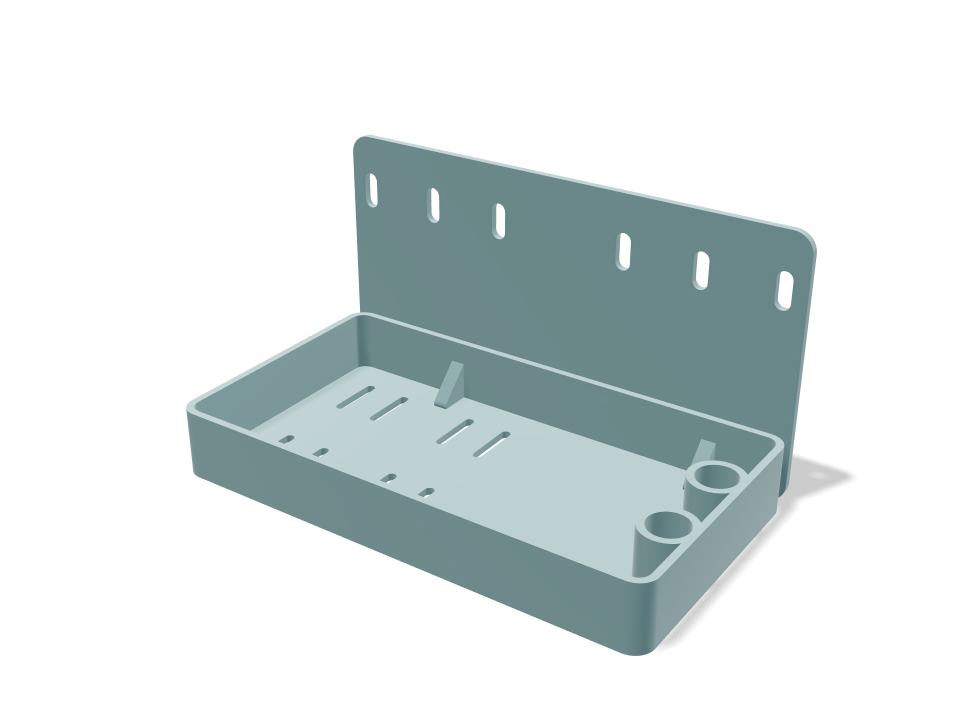
Building the model
Loading the 3D view
No adjustable sizes
Ask for the sizes you want to tweak, e.g. “make the width adjustable”.
Specs at the default size
Measured from the actual build on a Bambu Lab A1 in PETG. Every number updates live when you drag a slider above.
- Overall size
- 190 × 117 × 108 mm
- Parts
- 2
- Filament
- 167 g
- Print time
- 3 h 51 min
- Build plates
- 1
- Supports
- None needed
Engineering checks
- Keyhole install path clears both screw heads36 sampled poses; lift 10 mm then pull 25 mm forward; worst overlap 0.000 mm³
- Seated heads resist forward pull2 mm pull without lifting intersects each head by at least 43.2 mm³; lift first to release
- Keyholes remain inside the backplateside ligament 30.7 mm; top 11.7 mm; front skin 0.8 mm
- Keyhole lip bending estimate0.70 MPa versus 1.50 MPa (0.3x generic PETG Z allowance, a derating assumption); not a tested load rating
- Bottle floor bending estimate2.59 MPa versus 7.50 MPa; two panels with centre web, load spread over bottle diameter; 0.5x allowance is an assumption, wet creep unqualified
- Wall anchor pull-out demanddemand 9.6 N per screw; choose anchors rated at least 28.9 N pull-out and 44.1 N shear EACH in the actual wall; 60 N pull-out assumed, unverified
- Drainage under every stored item7 through-slots, 4 mm wide; brush and tube holders have open undersides
- Brush heads stay separate34 mm centre spacing for assumed 22 mm heads; 16 mm handle bores
- Bottle 1 envelope cleardiameter 48 mm; overlap 0.000 mm³
- Bottle 2 envelope cleardiameter 48 mm; overlap 0.000 mm³
- Wall screw 1 driver access before mountingcaddy and rack absent while driving; 36 poses clear the wall by volume, worst overlap 0.000 mm³
- Wall screw 2 driver access before mountingcaddy and rack absent while driving; 36 poses clear the wall by volume, worst overlap 0.000 mm³
- Rack seated without interferencetwo 6 mm locating pegs; 0.25 mm clearance per side; gravity seated, lifts out for cleaning
- Rack keys stop sideways slip1 mm lateral displacement meets the locating pockets; remove contents then lift the rack
- bottle 1 goes in58 poses along its path clear of every part.
- bottle 2 goes in58 poses along its path clear of every part.
- brush 1 assumed handle goes in28 poses along its path clear of every part.
- brush 2 assumed handle goes in28 poses along its path clear of every part.
- toothpaste assumed 38 by 24 mm goes in28 poses along its path clear of every part.
- driver: wall screw 1 BEFORE hanging caddy goes in18 poses along its path clear of every part.
- driver: wall screw 2 BEFORE hanging caddy goes in18 poses along its path clear of every part.
Adjustable sizes
| Setting | Default | Range |
|---|---|---|
| Width | 190 mm | 170–220 mm |
| Depth | 110 mm | 110–125 mm |
| Bottle diameter | 48 mm | 40–60 mm |
| Brush handle diameter | 14 mm | 10–20 mm |
| Wall screw centres | 120 mm | 80–140 mm |
| Contents mass | 1.5 kg | 0.5–2 kg |
Parts list
| Part | Qty | Size (mm) | Filament | Time |
|---|---|---|---|---|
| brush rack | 1 | 184 × 30 × 10 | 13 g | 21 min |
| caddy | 1 | 190 × 117 × 108 | 155 g | 3 h 30 min |
How to make it
- Measure your bottles and brush handles; the toothpaste opening is 40 by 26 mm, with room below for an assumed 38 by 24 mm tube.
- Set the width, depth, screw centres and contents mass. Choose anchors for the actual wall using the reported pull-out and shear demands.
- Drive two 4 mm shank / 8 mm head screws before hanging the empty caddy. With 2.4 mm thick heads, leave 3.3 mm under each head; engage the large openings and lower 10 mm.
Print tips
- Use PETG: caddy floor down, rack upper face down with its locating pegs upward.
- Inspect the small keyhole bridges in the slicer. Remove contents and lift out the rack to clean; validate printed fit, anchors and wet creep before use.
FAQ
Does the load check certify a safe capacity?
No. It estimates forces and printed-section stress using declared material and anchor assumptions. Wall construction, fasteners, layer bonding and long-term wet creep need physical validation.
Comments