Phone charging stand generator
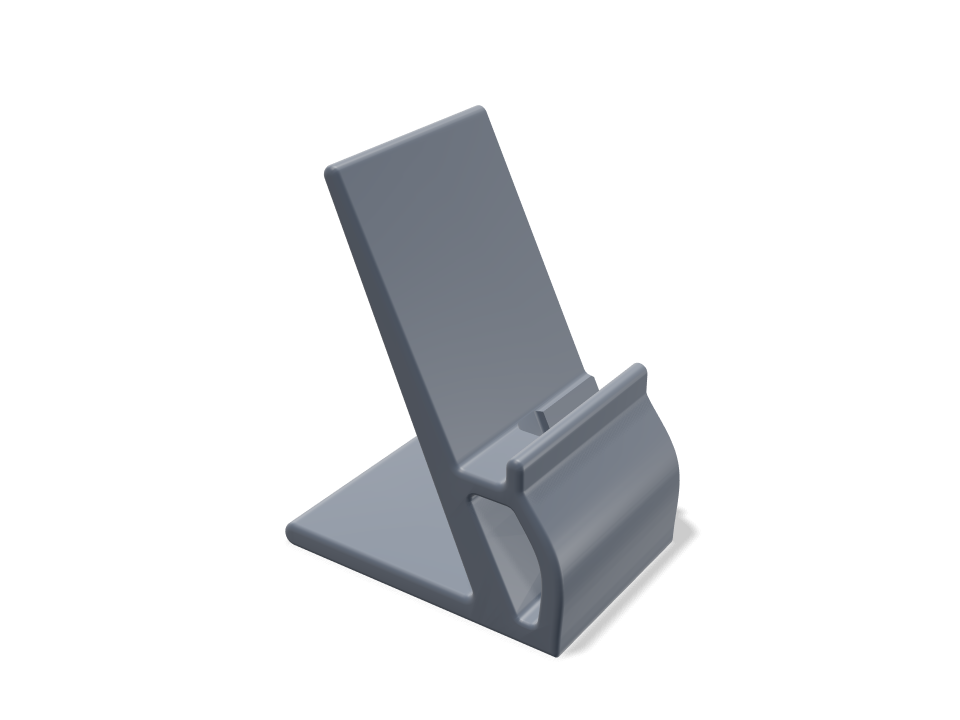
One blended side profile: a tapered backrest rising out of a long base, with a rounded window under the phone. The charging lead is planned in. The USB-C plug drops through a slot in the shelf, and the lead turns on a gentle radius, at least four times its diameter, inside the window. It then presses into a groove under the base and leaves out of sight at the back. The checks run at both ends of the common case range: the thickest case clears the lip, the thinnest phone is still held, the tallest phone stays balanced, and the plug and lead pass without touching.
Ask for the sizes you want to tweak, e.g. “make the width adjustable”.
Specs at the default size
Measured from the actual build on a Bambu Lab A1 in PLA. Every number updates live when you drag a slider above.
- Overall size
- 100 × 70 × 127 mm
- Parts
- 1
- Filament
- 68 g
- Print time
- 1 h 40 min
- Build plates
- 1
- Supports
- None needed
Engineering checks
- Thickest case clears the lipoverlap 0.0 mm³ with a 16 mm case; 1 mm designed gap
- Thinnest phone is still heldlip rises 5.5 mm above a 8 mm phone's front edge
- Stable with the tallest phonecentre of mass -38 mm, base ends at -62 mm
- Plug sits in its pocketoverlap 0.00 mm³ for 8-16 mm phones
- Lead lies free in its channeloverlap 0.00 mm³, 143 mm of lead inside the stand
- Lead bends gentlytightest bend 16 mm = 4.0x a 4 mm lead
- Lead slides into the shelf slit from the sidea 4 mm lead swept in 9 steps from outside the stand to the plug pocket: worst overlap 0.00 mm³
- Lead snaps into the base groove and stayskeyhole groove: 3.4 mm mouth for a 4 mm lead (the jacket squeezes through and is held); free once seated
- Lead hidden: leaves at the backnever in front of the chin; exits 14 mm behind the base
- phone (thickest case) goes in24 poses along its path clear of every part.
- USB-C plug goes in18 poses along its path clear of every part.
Adjustable sizes
| Setting | Default | Range |
|---|---|---|
| Lean angle | 64 deg | 55–75 deg |
| Width | 70 mm | 56–96 mm |
| Thickest phone + case | 16 mm | 10–18 mm |
| Charging lead diameter | 4 mm | 3–6 mm |
How to make it
- Set the thickest phone plus case you will use, and your lead's diameter.
- Choose the lean angle; 60–70° suits a desk.
- Print on its side, feed the plug down through the slot, and press the lead into the groove underneath.
Print tips
- Print on its side so the layers run along the backrest; no supports.
- PLA or PETG. Check your plug's overmould against the slot before printing a full stand.
FAQ
Will my plug fit through the slot?
The slot is sized for a common USB-C overmould with clearance. Plugs vary, so measure yours; the lead diameter control sets the channel.
Does it work with a thick case?
Yes. Set the thickest case you use. The checks prove it clears the lip while a thin phone is still held.
Comments