VESA screw length: what size to buy, and how long with a bracket or spacer
Retail size charts list M4 × 10 for 75 and 100 mm patterns, and for the 2.6 mm bracket the standard assumes it is right. Add a spacer, a thicker plate or a washer and the screw has to grow by exactly that much, and no more, or it bottoms out inside the TV.
Short answer
VESA 75 and 100 mm holes take M4 screws. The standard allows 7.4 mm of thread past the bracket and states its lengths for a 2.6 mm bracket, hence M4 × 10. Otherwise, screw length = bracket, plate, spacer and washer + the thread into the TV. Aim for 6 to 7.4 mm of thread unless your manual sets a different limit. Checked in the Loftsmith engine: a 4.5 mm printed plate plus a 0.8 mm washer takes M4 × 12, with 6.7 mm in the TV.
Retail size charts list M4 × 10 for 75 and 100 mm patterns, and for the 2.6 mm bracket the standard assumes it is right. Then you add something: a spacer to clear a bulge in the back of the TV, a thicker arm plate, a washer, or a printed mount for a streaming box. The screw has to grow by exactly that thickness. Too little and it holds by a few threads. Too much and it bottoms out in the TV’s insert before the head clamps anything.
This guide shows the arithmetic with real numbers, including one stack checked in the Loftsmith engine: a 4.5 mm PETG plate that hangs a streaming box from the same holes.
VESA screw sizes by pattern
| VESA part | Hole patterns (mm) | Thread | Thread into the display | Screw length with a 2.6 mm bracket |
|---|---|---|---|---|
| MIS-B | 20 × 50 | M4 | 4.0 mm | not stated |
| MIS-C | 35 × 75 | M4 | 5.4 mm | M4 × 8 |
| MIS-D | 75 × 75, 50 × 75, 100 × 100, 50 × 100 | M4 | 7.4 mm | M4 × 10 |
| MIS-E | 100 × 200, 50 × 200 | M4 | 7.4 mm | M4 × 10 |
| MIS-F | larger patterns | M6 | 9 mm min, 10 mm max, hole up to 12 mm | not stated |
| MIS-F | larger patterns | M8 | 12 mm min, 15 mm max, hole up to 16 mm | not stated |
That last column is where the retail answer comes from: 7.4 mm of thread plus a 2.6 mm bracket is exactly 10 mm, so 75 × 75 and 100 × 100 mounts ship with M4 × 10. It stops being right as soon as anything thicker than 2.6 mm sits under the screw head.
How to work out the length when you add a bracket, plate or spacer
screw length = stack + thread into the TV
The ceiling is the depth the hole allows: 7.4 mm by the standard, or your manual’s figure. The floor depends on what the thread is cut into, and you usually can’t see that. Roymech’s rule of thumb is at least 1 × the screw diameter for steel into steel and 1.5 × for brass. Some TVs use brass insert nuts set into the plastic back cover (a Sanyo patent describes exactly that), and from outside you can’t tell which you have, so for M4 aim for at least 6.0 mm in, and treat 4.0 mm as the absolute floor. Plastic would want 2 × D, 8.0 mm, which is deeper than the standard allows: one more reason the thread has to reach the metal insert.
- Measure the stack with calipers, every layer, squeezed together the way the screw will clamp it. An ISO 7089 M4 washer is 0.8 mm thick nominal, 0.7–0.9 mm in practice, so a real washer moves the result by about 0.1 mm.
- Work out the window. Shortest screw = stack + 6 mm. Longest = stack + your limit. For the standard’s 2.6 mm bracket with a washer, the stack is 3.4 mm and the window is 9.4 mm to 10.8 mm, so M4 × 10 still fits, with 6.6 mm in.
- Buy the stock length inside the window. The DIN EN ISO 7045 pan-head table lists M4 lengths including 8, 10, 12, 14, 16, 20 mm, with 14 mm marked non-preferred. It exists, but it is the one you are least likely to find in a hardware store.
- Check where the length is measured. For pan, cheese, socket, button and hex heads it is from under the head to the tip. For countersunk heads it is from the surface line, which for a flat countersunk head means the whole screw.
- Measure the hole if you are unsure. Push a toothpick or the tail of a zip tie into the hole until it stops, pinch it at the surface and measure. Then thread each screw in by hand before you tighten anything: if it stops before the head seats, it is too long.
Turns are an easy check. M4 coarse thread advances 0.7 mm per turn, so 6.0 mm of engagement is about 8.5 turns and 7.4 mm is about 10.5. Mountspec’s rule of about 5 full turns is only 3.5 mm on M4, less than one screw diameter.
Printed plate thickness vs M4 screw length
A printed plate is thicker than a steel bracket, because plastic needs the material. So the screw grows with it. The table runs the same stack the engine check reports (plate + 0.8 mm washer) across the plate slider of the Loftsmith streaming box cradle, which goes from 3 to 6 mm and builds with every check passing at both ends.
| Printed plate | Stack | M4 × 10 | M4 × 12 | M4 × 14 | M4 × 16 |
|---|---|---|---|---|---|
| 3 mm | 3.8 mm | 6.2 mm, fits | 8.2 mm, bottoms out | 10.2 mm, bottoms out | 12.2 mm, bottoms out |
| 4 mm | 4.8 mm | 5.2 mm, short for brass | 7.2 mm, fits | 9.2 mm, bottoms out | 11.2 mm, bottoms out |
| 4.5 mm (default, engine-checked) | 5.3 mm | 4.7 mm, short for brass | 6.7 mm, fits | 8.7 mm, bottoms out | 10.7 mm, bottoms out |
| 5 mm | 5.8 mm | 4.2 mm, short for brass | 6.2 mm, fits | 8.2 mm, bottoms out | 10.2 mm, bottoms out |
| 6 mm | 6.8 mm | 3.2 mm, too short | 5.2 mm, short for brass | 7.2 mm, fits | 9.2 mm, bottoms out |
The engine’s result for the default plate: M4 × 12 with a washer, 5.3 mm through plate and washer, 6.7 mm into the TV, inside the 7.4 mm usable depth set on the model. Do the window by hand and you get the same answer: 5.3 mm + 6 = 11.3 mm at the short end, 5.3 mm + 7.4 = 12.7 mm at the long end, and M4 × 12 is the stock length between them.
Stock lengths that fit, by plate:
- 3 mm plate: M4 × 10 (6.2 mm in)
- 4 mm plate: M4 × 12 (7.2 mm in)
- 4.5 mm plate: M4 × 12 (6.7 mm in)
- 5 mm plate: M4 × 12 (6.2 mm in)
- 6 mm plate: M4 × 14 (7.2 mm in)
The thickest plate is the awkward one: at 6 mm only M4 × 14 fits, the non-preferred length. Use M4 × 12 instead and you get 5.2 mm, short for a brass insert. M4 × 16 bottoms out on every plate in this range; if the bag of screws that came with a mount has those, they are for a thicker stack.
If your manual gives a different depth, set the model’s thread-depth slider (it goes from 6.5 to 12 mm) and the page works the screw out again. Change the plate and the screw together; don’t thin a plate just to use the screws already in the drawer.
One part for both 75 and 100 mm patterns: slots and washers
Short slots let one plate serve both MIS-D patterns. In the cradle, the engine places the M4 shank at ±37.5 and ±50 mm and finds 0.00 mm³ of overlap with the plastic at both positions. The slot mouth is 5.3 mm. For comparison, the standard calls for 5 mm bracket holes, because each hole on the TV may sit ±0.25 mm off its nominal position, and Loftsmith’s round M4 clearance hole is 4.5 mm (the screw hole sizes guide explains why printed holes are modelled larger than the screw).
The washer is what makes a slot safe on plastic. The 9 mm washer sits 100% on flat plate, with at least 1.85 mm of bearing on each side of the slot, checked in the Loftsmith engine. Without it, an M4 socket head, which Loftsmith’s hardware table models at 7.2 mm across, would bear on 0.95 mm each side of the same slot (our arithmetic): a thin plastic edge carrying the whole clamp force.
Printed holes and slots come out a little small, and PETG often wants slightly more clearance than PLA. If yours won’t take the screw, find your printer’s offset with a tolerance test rather than drilling the part; the 3D printing tolerances guide explains how to read it.
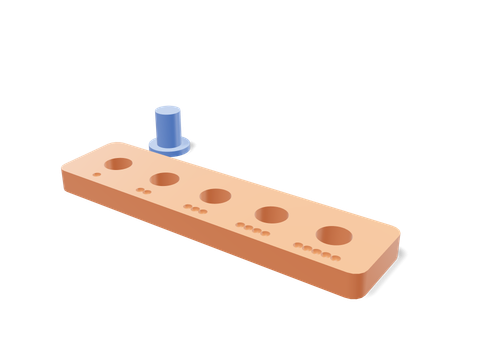 Tolerance testerA ladder of holes and pegs that shows how much clearance your printer and filament need.71 × 35 × 10 mm · 5 g · 21 min
How much load the screws really see
For an accessory hung from VESA holes, the numbers are small. With the default 0.22 kg box and a bump (the check doubles the load), the engine reports about 7 N of pull per screw, and 0.46 MPa at the root of each corner stop against PETG’s 5.0 MPa allowable across the layers: about 9% of it. The model builds and passes every check for boxes up to 1 kg.
For scale, the VESA table rates MIS-D 75 for displays up to 8 kg and MIS-D 100 up to 14 kg on the same four M4 screws. On a printed mount, the checks that matter are on the plastic: where it bends, which way the layers run, and how warm it gets. The guide to how much weight printed parts hold has the bending arithmetic.
The cradle is PETG rather than PLA because the back of a TV runs warm. The PLA vs PETG vs ASA comparison has the softening temperatures for each.
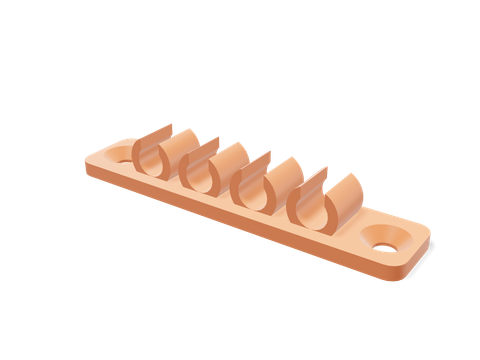 Cable organizerSnap-in clips sized to your cable, screwed or taped down, to keep the HDMI and power leads tidy once the box is up.74 × 16 × 11 mm · 5 g · 11 min
When not to use a printed plate or longer screws
- Never a printed plate or printed spacer between a TV and its wall mount or arm. That puts printed plastic, with its layer lines and creep, in the TV’s load path. Use the mount maker’s spacers and the formula above. If the bracket already uses all four holes, put the box on a small shelf instead.
- Never a screw that bottoms out. Samsung’s wall-mount terms warn that screws longer than the standard dimension may damage the inside of the product, and that over-tightening can damage it or let it fall. Hand-thread first, every time.
- Not the 200 mm option, from this guide. MIS-F mounts use M6 or M8 with their own depths (see the table above). The cradle’s 200 mm pattern built, but its screw and washer check was only run for M4 at 75 and 100 mm, so nothing here covers it.
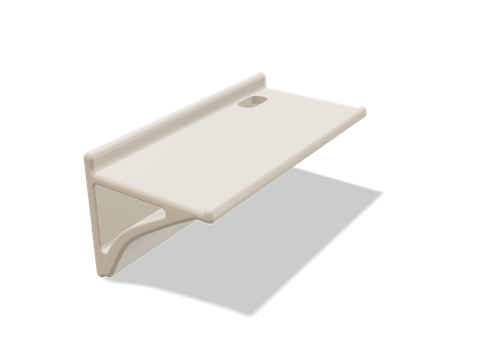 One-piece keyhole shelfA one-piece wall shelf on hidden keyholes, with its deck load and screw pull-out checked.90 × 180 × 83 mm · 134 g · 3 h 16 min
How these numbers were checked
The Loftsmith team wrote this guide. The engine figures come from the build report of 2026-10-04 for the Workshop model Apple TV VESA mount behind the TV, sized to your box: Bambu Lab A1 profile, PETG, default sliders, 16 checks passed, every slider extreme built with no failed check, and two review rounds. The model prints flat without supports, about 67 g and 1 h 35 min at 2 walls and 15% infill, up to 117 g and 2 h 45 min at 4 walls and 25%. Clamping the cradle between the TV and a wall bracket was left out of the model, and its 200 mm option isn’t covered here, because neither was checked.
The standard’s sizes come from Wikipedia’s VESA mount table. VESA offers the FDMI standard as a free download through a form on its site; we used Wikipedia’s summary and have not quoted the standard directly. Engagement rules are Roymech’s, washer sizes ISO 7089, stock lengths DIN EN ISO 7045.
What this won’t tell you: nothing here was printed, torqued or pull-tested, and we measured no real TV inserts. Engagement figures assume the standard’s 7.4 mm depth. You can’t tell from outside whether a hole is a brass insert, a steel nut or threaded sheet metal, so the 6 mm floor is a cautious default, not a measurement.
Questions people ask
What size screws does a VESA 100 mount use?
M4. Both 75 × 75 and 100 × 100 are part MIS-D of the VESA standard, which allows 7.4 mm of thread past the bracket. With the 2.6 mm bracket the standard assumes, that makes M4 × 10. Larger patterns (part MIS-F) use M6 or M8; check your manual.
Can a VESA screw be too long?
Yes. A screw that runs out of hole bottoms out before its head clamps the bracket, so the mount stays loose, and forcing it can damage the insert or the set. Samsung’s wall-mount terms warn that longer screws may damage the inside of the product. Thread each screw in by hand first: if it stops before the head seats, it is too long.
How long should VESA screws be with a spacer?
Add the spacer to everything else under the screw head (bracket, plate, washer), measured with calipers, then add 6 to 7.4 mm of thread, or your manual’s limit. Buy the stock length in that window. A 4.5 mm plate plus a 0.8 mm washer is 5.3 mm, which makes M4 × 12 the only stock length that fits.
How many turns should a VESA screw go in?
M4 coarse thread has a 0.7 mm pitch, so 6 mm of engagement is about 8.5 turns and 7.4 mm about 10.5. Mountspec’s rule of about 5 full turns is only 3.5 mm on M4, less than one screw diameter.
Do all displays follow the 7.4 mm figure?
No. One LG TV manual says the screw must go less than 8 mm past the back cover. Elektron, for the VESA holes on its Digitakt drum machine, wrote that its manual says 7 mm to be safe. Use the figure in your own manual when it gives one.
Sources and method
The numbers come from Loftsmith’s CAD engine, which uses them to design and check every part it builds, and from the manufacturer and reference sources below. Every figure is checked against those sources and the engine’s own geometry. Found a mistake? Email [email protected] and we’ll fix it.
- Wikipedia: VESA mount (screw table, lengths excluding the bracket)
- VESA: standards list (FDMI offered as a free download)
- LG 22/28LY-series TV owner’s manual, wall mounting page (ManualShelf)
- Samsung: HE terms and conditions (wall-mount screw warnings)
- Elektronauts: Elektron staff on VESA screw lengths for the Digitakt
- Mountspec: TV mount screw sizes (the five-turns rule)
- Roymech: thread calculations (minimum engagement)
- US7561423B2 (Sanyo): video display with insert nuts at the mounting holes
- Engineers Edge: ISO 7089 flat washer table
- Aspen Fasteners: M4 DIN 125 A / ISO 7089 washer tolerances
- GlobalFastener: DIN EN ISO 7045 pan head screw lengths
- Measuring fastener length (chart courtesy of Bolt Depot)
- Wikipedia: ISO metric screw thread (M4 pitch)