How to turn an empty filament spool into an extension cord reel (and how much cord fits)
An empty 1 kg spool is most of a cord reel already. What it lacks is a handle that stays still while it turns, a crank, and a straight answer to how much cord fits. Here are all three, with the numbers the engine checked.
Short answer
A 200 mm, 1 kg spool holds about 19.4 m (64 ft) of 8 mm round cord on a 90 mm core, by the Loftsmith engine’s estimate at a 0.75 packing factor; that is about 58 ft of 16/3 cord. A printed snap-in hub with a crank turns it: about 95 g of PETG, 2 h 53 min, no supports or screws, though the drive peg needs a 10 mm opening in the flange. Checked in the engine, not yet printed.
Every printer owner ends up with a stack of empty spools, and every garage has an extension cord in a knot. The two problems solve each other: a 1 kg spool is a ready-made reel with a 200 mm flange. What it lacks is a handle to hold while it turns, and a crank to turn it.
This guide answers the two questions the model listings skip: how much cord of a given thickness fits, and which spools a printed hub fits. The numbers come from a hub designed and checked in the Loftsmith engine on 8 October 2026. It has not been printed yet, and the guide says so wherever it matters.
Measure your spool first: bore, width and core
Four numbers decide whether a hub fits and how much cord the spool holds:
- Bore: the diameter of the hole in the middle. The hub’s snap fingers hook its far edge.
- Width: across the spool, outside flange to outside flange. The hub’s sleeve is sized to it.
- Inside width: the gap between the flanges, where the cord actually winds. The capacity formula below needs it.
- Core: the diameter of the barrel the filament was wound on. Cord winds on it too.
There is no standard for any of them. The hub’s sliders cover bores of 50–58 mm and widths of 55–75 mm. The table shows where common 1 kg spools land, and how sure we are of each figure.
| Spool | Bore | Width | Outside | Inside the sliders? | Source | Status |
|---|---|---|---|---|---|---|
| Bambu Lab reusable spool | 55 mm | 67 mm | 200 mm | Yes | 3DJake | Confirmed on two retailer pages |
| Hatchbox | 55.9 mm | 68.3 mm | 200 mm | Yes | Amazon listing | As listed; page not opened by us |
| American Filament | 52 mm | 67 mm | 200 mm | Yes | maker’s FAQ | As listed; page not opened by us |
| Polymaker (cardboard) | 55 mm | 65.6 mm | 200 mm | Sizes yes; cardboard (see below) | maker’s product page | As listed; page not opened by us |
| eSun (cardboard) | 51.5 mm | 63.5 mm | 200 mm | Sizes yes; cardboard (see below) | retailer listing | As listed; page not opened by us |
| Prusament | 50 mm | 69 mm | 199 mm | Yes, at the bottom end | user measurement, Prusa forum | One user’s measurement (2019) |
The drive peg and the hole it needs
The hub’s sleeve sits in a round bore, so on its own the crank would just spin the hub inside the spool. The drive peg is what locks them together: an 8 mm peg on the crank paddle that reaches into the flange resting on the paddle, 39.5 mm from the centre (the build log’s peg radius). The engine checks it in a 10 mm hole.
- If that flange has an opening at least 10 mm across, 39.5 mm from the centre of the bore, the peg drops into it.
- If not, mark a point 39.5 mm from the centre and drill a 10 mm hole through the flange. That is the one tool the reel needs.
The build report doesn’t record which spools have a matching opening, so check yours before you print. While you are there: at the default 60 mm crank the paddle reaches 73 mm from the centre, inside the 100 mm rim radius of a 200 mm spool.
How much extension cord fits on a filament spool
The engine estimates capacity as the ring between the core and a line 5 mm under the rim, times the winding width W between the flanges, times a packing factor of 0.75, divided by the cord’s cross-section. The packing factor accounts for round cord leaving gaps between turns. For a round cord:
cord length ≈ 0.75 × W × (D² − c²) ÷ d²
W is the winding width inside the flanges, D is the spool’s outside diameter minus 10 mm (190 mm on a 200 mm spool), c is the core diameter and d the cord diameter, all in mm. The answer is in mm; divide by 1,000 for metres.
The build report doesn’t state the winding width it uses. Worked backwards from its 19.4 m result, the formula gives about 59 mm, and the cord the model draws on the spool is 58 mm wide. With the 67 mm outside width instead you would get 22.0 m, so measure inside the flanges.
| Cord diameter | 70 mm core | 90 mm core | 120 mm core |
|---|---|---|---|
| 5 mm | 55.3 m (182 ft) | 49.7 m (163 ft) | 38.5 m (126 ft) |
| 6 mm | 38.4 m (126 ft) | 34.5 m (113 ft) | 26.7 m (88 ft) |
| 8 mm | 21.6 m (71 ft) | 19.4 m (64 ft) | 15.0 m (49 ft) |
| 10 mm | 13.8 m (45 ft) | 12.4 m (41 ft) | 9.6 m (32 ft) |
| 12 mm | 9.6 m (32 ft) | 8.6 m (28 ft) | 6.7 m (22 ft) |
Which cord is which
Extension cords are sold by gauge, not by diameter. Cord makers and distributors publish a nominal outside diameter for each type; these are typical values and vary by maker. Measure your own cord where it is round, away from the plug.
| Cord | Nominal outside diameter | Estimated length | Spec source |
|---|---|---|---|
| 16/3 SJTW | 0.331 in (8.4 mm) | 17.6 m (58 ft) | Etlin Daniels |
| 14/3 SJT | 0.365 in (9.3 mm) | 14.4 m (47 ft) | Allied Wire & Cable |
| 12/3 SJT | 0.43 in (10.9 mm) | 10.4 m (34 ft) | Allied Wire & Cable |
Starting the wind
The hub fills the bore, so the first plug can’t go through the middle, and the build report lists no slot or clip for the cord end. Tape the plug flat against the core, or feed it out through an opening in the flange, then wind the first turns over it.
Real reels hold less than the estimate. The plugs take room, the first turns won’t lie tight against the core, and a hand-cranked cord winds looser than a machine-wound one. The designers who publish figures for their spool reels land below these numbers: the DarkerView design on Cults3D says 50 ft of light-duty or 25 ft of heavy-duty cord on a 55 mm-bore spool, and the BusinessCat Overture-spool reel says 50 ft of 14-gauge. Plan on a 50 ft cord of 16/3, or 25 ft of 12/3, and you won’t be fighting the last few turns.
How the hub holds in the bore without screws
The hub is a sleeve that goes through the bore. A fixed lip stops it on one side; six snap fingers on the other side flex inward as you push, then spring out and hook the far edge of the bore. No screws, and nothing to undo when you want the spool back.
| Check | Result | Limit |
|---|---|---|
| Finger strain while pushing in | 0.75% | 5% (half PETG’s 10% elongation at break) |
| Catch past the far bore edge | 1.05 mm | Hooks the far edge |
| Push-in force | About 6 kg | A firm two-hand press |
| How far the fingers flex in | 1.2 mm | Stay 14.8 mm clear of the grip axle |
| Grip through the bore | 37 mm grip | 55 mm bore |
A snap fit has two ways to fail, and they pull in opposite directions. A smaller bore bends the fingers further, so strain goes up; a bigger bore leaves less of the hook behind the edge, so the catch goes down. That is why the engine rebuilt the hub at both ends of the bore slider, 50 mm and 58 mm. Both built and passed every check. The arithmetic behind the strain figure is in the snap-fit design guide.
The hub is designed in PETG, for two reasons. The engine’s material profiles give PETG 10% elongation at break against PLA’s 4%, 2.5 times as much, so a PETG finger bends much further before it cracks. And a reel often lives in a garage or a car boot that gets warm. The PLA vs PETG vs ASA comparison covers the heat side.
A print-in-place grip that turns while you crank
To wind, you hold a handle still in one hand while the spool turns around it. Here that handle is a fluted grip on an axle that prints inside the hub’s sleeve, already assembled, on a captive bearing.
- Running gap: 0.3 mm between the axle and the sleeve at the default; the slider runs 0.2–0.5 mm, and the hub builds and passes at both ends.
- Captive: a 1.77 mm capture flank blocks the axle both ways along its length, and every captive body is held by at least 0.8 mm, two perimeters.
- Motion: the engine swept a full winding turn in 145 poses, at most 5° apart, and the knob through a full turn on its pin in 73. Nothing touched.
Pick the gap the way you would for a hinge: print the tolerance test in the PETG you’ll use and take the first gap that turns freely. The print-in-place hinge guide explains why tight print-in-place gaps fuse, and why the first layer is usually the culprit.
The hub prints standing up with the grip axle inside it, which makes it 177.6 mm tall at the default 67 mm spool width. That is the number to check against your printer:
| Printer | Build height | Room left |
|---|---|---|
| Bambu Lab A1 mini | 180 mm | 2.4 mm |
| Prusa MK4S | 220 mm | 42.4 mm |
| Creality Ender-3 V3 | 250 mm | 72.4 mm |
| Bambu Lab A1 | 256 mm | 78.4 mm |
On an A1 mini that leaves 2.4 mm at the default width. The report gives the height only at that width, and its slider-end builds ran on the A1 profile with 256 mm of height. The axle runs through a sleeve sized to the spool, so a wider spool will most likely make the print taller: on a printer with 180 mm of height, set your width in the model and check the height before you start the 2 h 15 min hub print.
Will the crank snap? The load checks
Winding a cord isn’t a heavy job, but a crank turns a small pull into a large twist, and the parts that carry it are small. The engine checks three of them against PETG’s strength across the layers, where printed parts are weakest:
| Part | Load case | Stress | Allowed |
|---|---|---|---|
| Drive peg, 8 mm in a 10 mm hole | 30 N pull on the knob, ×2 for a jolt, at 60 mm | 3.6 MPa | 5 MPa |
| Knob pin shoulder | 30 N pull on the knob | 3.5 MPa | 5 MPa |
| Grip axle, at the root of the grip | A 2 kg reel, ×2 for a jolt | 3.4 MPa | 5 MPa |
| Knob snap prongs | Barb passing the hole on assembly | 2.14% strain | Passes |
Why across the layers? The grip axle prints standing up, so when the reel’s weight bends it, the bend opens its layer lines, and the drive peg and knob pin take sideways loads the same way. The lower figure is the honest one to check against. The method, and why a jolt counts double, is in the guide to how much weight printed parts hold.
The crank slider runs 40–80 mm. A longer crank turns the spool with less effort, but the same pull at a longer arm puts more twist through the drive peg, so its stress rises with the crank length. The engine rebuilt the hub at 80 mm and the peg still passed.
Printing it: parts, grams and time
Two prints make four parts: the hub with its grip axle inside, and the knob on its pin, which then snaps into the crank arm. Nothing needs supports.
| Part | Size | Filament | Time | Overhang |
|---|---|---|---|---|
| Hub (sleeve, fingers, crank paddle, drive peg) | 121.5 × 73.0 × 79.1 mm | 48 g | 72 min | 0.0% |
| Grip axle (prints inside the hub) | 37.0 × 37.0 × 177.6 mm | 32 g | 63 min | 0.1% |
| Knob pin | 20.0 × 20.0 × 52.7 mm | 4 g | 15 min | 0.6% |
| Knob (prints on its pin) | 27.0 × 26.0 × 44.0 mm | 8 g | 18 min | 1.1% |
| Setting | Filament | Time |
|---|---|---|
| 2 walls, 15% infill | 95 g | 2 h 53 min |
| 3 walls, 15% infill | 125 g | 3 h 46 min |
| 3 walls, 20% infill | 131 g | 3 h 59 min |
| 4 walls, 20% infill | 159 g | 4 h 49 min |
| 4 walls, 25% infill | 164 g | 4 h 59 min |
The defaults quoted in this guide are at 2 walls and 15% infill. The drive peg and the grip axle carry the crank load, and in bending the walls do most of the work, so 3 walls is a reasonable step up for 30 g and 53 minutes more.
Limits, and using a cord reel safely
This is a storage reel. Nothing touches the wiring: no outlet moved into the hub, no cut cord. Unwind the cord fully before you plug anything into it.
Bayco’s cord-reel manual says to pull the cord out to full length when using it. Brennenstuhl, which makes cable reels, explains why: a wound cable can’t shed the heat the current makes, so the core of the coil gets very hot, with a risk of insulation damage and fire. Its own reels can be used partly wound only within a rolled-up load rating marked on the reel, and they carry a thermal cutout that trips at about 65 °C. An ordinary extension cord on a printed spool has neither, and the engine’s PETG profile puts the hub’s heat deflection at 70 °C.
What the engine didn’t check:
- Continuous motion, friction and wear: the motion checks are sampled rigid poses.
- Loads while moving, flex, and any hardware outside the model, including your spool.
- Dropping a full reel, or a spool flange cracking around the drive peg.
- Cardboard spools, spools other than the 200 mm one it was checked in, and the print height at widths other than 67 mm.
The model also went through Loftsmith’s Workshop review. It passed on the first round with nothing it had to fix, and scored 4 of 5 for usefulness, 4 for correctness, 5 for honesty, and 3 of 5 for looks: it is a functional part, and it looks like one.
Sources and method
Written by the Loftsmith team. The hub numbers come from the Loftsmith engine’s build report of 8 October 2026, made with the Bambu Lab A1 profile, PETG and the default sliders (bore 55 mm, width 67 mm, crank 60 mm, gap 0.3 mm, cord 8 mm, core 90 mm). The report holds 16 checks, all passed, and 12 rebuilds at the ends of the six sliders, all of which built and passed. The capacity tables scale the engine’s 19.4 m result with its own formula; the 59 mm winding width is worked back from that result, not read from the model.
Spool and cord sizes come from the maker, retailer and distributor pages linked in the tables, and the spool table says which of those pages we could open. Competitor capacities are those designers’ own claims. Safety advice comes from the reel makers linked above.
Not tested: nothing in this guide has been printed, wound or load-tested. When it has, the results will go here.
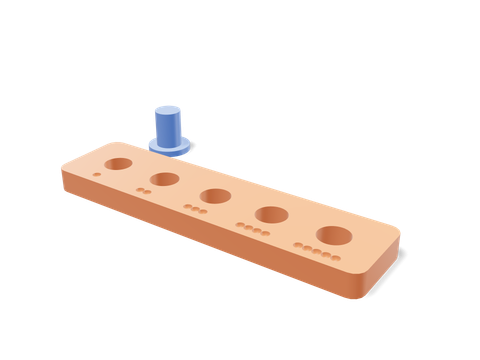 Tolerance testerFind the running gap your printer makes in PETG before you set the grip’s gap slider.71 × 35 × 10 mm · 5 g · 21 min
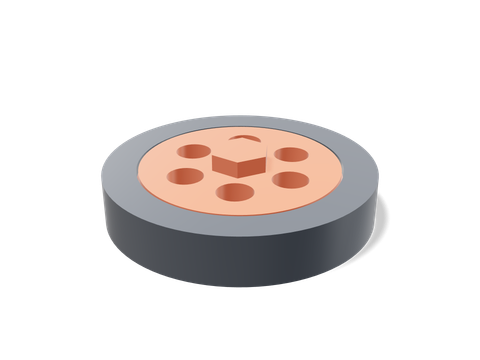 Captive rotary fidgetA captive ring that prints in place, the same trick as the grip on a smaller scale.32 × 32 × 8 mm · 4 g · 15 min
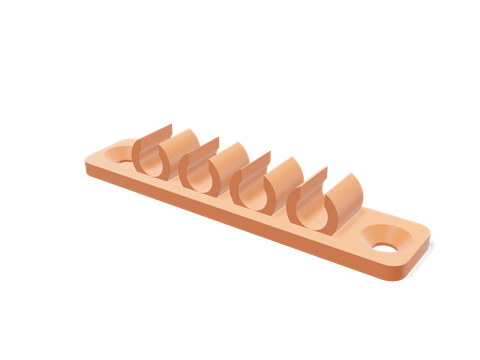 Cable organizerSnap-in clips sized to your cable, for the cords that stay plugged in.74 × 16 × 11 mm · 5 g · 11 min
The hub itself is a free Workshop model: open the filament spool cord reel hub, enter your spool’s bore and width and your cord’s diameter, and the engine rebuilds and rechecks it.
Questions people ask
How many feet of extension cord fit on a 1 kg filament spool?
About 64 ft of 8 mm cord on a 90 mm core of a 200 × 67 mm spool, by the Loftsmith engine’s estimate. For common US cords that is about 58 ft of 16/3, 47 ft of 14/3 and 34 ft of 12/3. Narrower spools hold proportionally less, and plugs and loose hand-winding cut it further, so a 50 ft 16/3 or a 25 ft 12/3 cord is a comfortable fit.
What size is the hole in a filament spool?
There is no standard. The Bambu Lab reusable spool’s bore is 55 mm; listings give 52 mm for American Filament and about 56 mm for Hatchbox, and one user measured 50 mm on a Prusament spool. Brands change spools between production runs, so measure yours with calipers before you print a hub.
Can I use a cardboard spool as a cord reel?
It is risky with a snap-in hub. The hub takes about 6 kg to push in and its checks assume a rigid plastic bore; cardboard can crush or tear under the fingers. Use a plastic spool.
Can I use an extension cord while it is still wound on the spool?
No. Unwind it fully before you plug anything into it. Bayco’s cord-reel manual says to pull the cord out to full length when using it, and Brennenstuhl explains why: a wound cord traps the heat the current makes. Brennenstuhl’s own reels allow partial use only within a rolled-up rating and carry a thermal cutout; a printed spool has neither, and the engine’s PETG profile puts the hub’s heat deflection at 70 °C.
Will the reel hub print on a Bambu Lab A1 mini?
At the default 67 mm spool width, yes: the hub prints standing up with its grip axle inside and is 177.6 mm tall, against the A1 mini’s 180 mm build height. The build report gives the height only at that width, and a wider spool most likely makes the print taller, so set your width in the model and check the height before printing on a 180 mm printer.
Sources and method
The numbers come from Loftsmith’s CAD engine, which uses them to design and check every part it builds, and from the manufacturer and reference sources below. Every figure is checked against those sources and the engine’s own geometry. Found a mistake? Email [email protected] and we’ll fix it.
- 3DJake: Bambu Lab reusable spool (200 mm, 55 mm bore, 67 mm wide)
- Prusa Forum: Prusament spool size (user measurements)
- Etlin Daniels: 16/3 SJTW power cord specification
- Allied Wire & Cable: SJT 14/3 specification
- Allied Wire & Cable: SJT 12/3 specification
- Brennenstuhl: why you should always unwind a cable reel completely
- Bayco 800 Series cord reel instruction manual (ManualsLib)