Dust collection adapter sizes: the hose and port diameters that actually fit
The first adapter you print for the shop vac falls off because you typed the number on the box. Here are the sizes sellers actually publish, the two questions to answer before you model, and the taper that makes a cuff grip.
Short answer
A hose sold as “2-1/2 inch” is about 63.5 mm across the hose body, but its cuff and the vac inlet it plugs into are 2-1/4 in (57.2 mm) outside and about 52.4 mm inside; a “4 inch” hose is 101.6 mm inside and slides over a 4 in port. Festool D 27 is 27 mm inside and 32 mm outside, D 36 is 36 mm. Measure the surface your adapter will touch, decide whether that end goes inside or over it, and give the cuff about 0.4 mm of clearance at the tip and 0.8 mm of taper so the hose jams on and still pulls off by hand.
The first adapter you print for your shop vac will probably fall off. Not because the printer is bad, and not because you can’t measure. Because you typed the number on the box. A “2½ inch” hose is not two and a half inches anywhere a caliper can reach, and the port on the saw that also says 2½ is a different size again. This guide gives you the measured sizes behind the names, the two questions to answer before you model anything, and the clearance and taper that make a printed cuff grip.
The chart: names and measured sizes
| Name on the box | Outside Ø | Inside Ø | Source |
|---|---|---|---|
| “2-1/2 in” hose | 63.5 mm | — | Oneida |
| “2-1/2 in” hose cuff and vac inlet | 57.2 mm | 52.4 mm | Rockler |
| “2-1/2 in” fitting, measured | 62.7 mm | 57.9 mm | Powertec |
| 2-1/2 in tool port (router fence) | 63.5 mm | 57.2 mm | Rockler |
| “1-7/8 in” hose (Ridgid, Craftsman, Shop-Vac) | — | 47.6 mm | Rockler |
| “1-1/4 in” hose and wand | 31.8 mm | 31.8 mm | Rockler |
| 1-1/2 in small-tool hose | — | 38.1 mm | Rockler |
| “4 in” dust collection hose | — | 101.6 mm | Rockler |
| “4 in” fitting, measured | 100.4 mm | 92.5 mm | Powertec |
What each seller says
- “2-1/2 in” hose: The label is the outside of the hose body. Oneida: the end cuff is 2-1/4 in so it can enter the vac inlet. (Oneida Air: 2 in to 2.25 in plastic vacuum hose adapter)
- “2-1/2 in” hose cuff and vac inlet: Rockler’s adapter: 2-1/4 in outside, 2-1/16 in inside, “fits standard 2-1/4 in I.D.” ports. Bosch: vacs have a “standard 2-1/4 in opening”. (Rockler: shop vac dust fitting adapter, 1-1/4 to 2-1/4 in)
- “2-1/2 in” fitting, measured: Powertec prints the real dimensions of its cone reducer: 2-15/32 in outside, 2-9/32 in inside. (Powertec 70136: 4 in to 2-1/2 in cone reducer (measured dimensions))
- 2-1/2 in tool port (router fence): Rockler’s router table port: 2-1/2 in outside, 2-1/4 in inside, so a 2-1/2 in hose goes over it and a 2-1/4 in cuff goes in. (Rockler: router table dust port)
- “1-7/8 in” hose (Ridgid, Craftsman, Shop-Vac): Sold by inlet size only; no maker publishes the cuff’s outside diameter. Measure yours. (Rockler: Measuring dust ports and dust hoses)
- “1-1/4 in” hose and wand: Rockler: 1-1/4 in outside-diameter wands fit a 1-1/4 in inside-diameter port. The small end of most vac kits. (Rockler: shop vac dust fitting adapter, 1-1/4 to 2-1/4 in)
- 1-1/2 in small-tool hose: Rockler’s small-port kit: 1-1/2 in inside, with ports of 3/4, 1, 1-1/4 and 1-1/2 in inside diameter and a 2-1/4 in vac end. (Rockler: Dust Right universal small port hose kit)
- “4 in” dust collection hose: 4 in inside. Rockler: a 4 in table-saw port is 4 in outside, so the hose slides over it, “snug but perfect”. The hose’s outside is not published. (Rockler: Dust Right 4 in anti-static dust hose)
- “4 in” fitting, measured: Powertec’s measured 4 in end: 3-61/64 in outside, 3-41/64 in inside. It fits hoses, not 4 in equipment ports. (Powertec 70136: 4 in to 2-1/2 in cone reducer (measured dimensions))
| Hose | Outside Ø | Inside Ø | Source |
|---|---|---|---|
| Festool D 27 | 32 mm | 27 mm | Festool |
| Festool D 36/32 | 36 mm | 32 mm | Festool |
| Festool D 36 | 36 mm | — | Festool |
| Bosch 35 mm | 35 mm | — | Bosch |
| Makita 28 mm | 32 mm | 28 mm | Makita |
- Festool D 27: 27 mm inside, 32 mm outside; the hose end fits inside a Festool tool port. (Festool D 27/32 x 3.5 m AS/90 hose (dealer listing with inner and outer diameters))
- Festool D 36/32: Festool: “conical geometry (32 mm to 36 mm)”. The 36 mm end fits over the tool port. (Festool D 36/32 x 3.5 m AS/R suction hose)
- Festool D 36: 36 mm, for machines with a 36 mm connection. (Festool D 36 x 5 m AS/CTR suction hose)
- Bosch 35 mm: VAC005 is a 35 mm hose; the VAC020 tool end is 1-3/8 in (35 mm) outside and its vac end 2-1/4 in. (Bosch VAC020 hose (2-1/4 in vac end, 1-3/8 in tool end))
- Makita 28 mm: 28 mm inside, 32 mm outside. Makita extractors ship 28 mm and 38 mm hoses with a 24 mm front cuff and a 22 mm adapter. (Makita 195433-3 28 mm hose (dealer listing with inner and outer diameters))
Two things stand out. The whole North American “2½ inch” family is built around a 57.2 mm cuff that plugs into a 57.2 mm inlet with about 52.4 mm of bore; the 63.5 mm figure is the hose body, which touches nothing. And the “4 inch” family is the other way round: the hose is 101.6 mm inside and slides over a 101.6 mm port. Powertec’s measured reducer shows how loose the names are in practice: its “2½” end is 62.7 mm outside and 57.9 mm inside, and its “4 inch” end is 100.4 mm outside.
Tool ports people ask about
| Tool | Port | Source |
|---|---|---|
| DeWalt DW735 planer | 4 in (100 mm); a 2-1/2 in adapter is in the box | DeWalt |
| Many North American “2-1/2 in” tool ports | 55 to 60 mm outside (the range DeWalt’s DWV9140 adapter covers) | DeWalt |
| 35 mm tools (Festool-style ports) | 35 mm (1.37 in) outside | DeWalt |
| Rockler router table fence | 2-1/2 in outside, 2-1/4 in inside | Rockler |
| Rockler 4 in table-saw port | 4 in outside; a 4 in hose slides over it | Rockler |
When a maker gives no number, the port is still easy to measure: calipers across the outside of the spigot, then across the inside. Measure in two places at right angles; moulded ports are often slightly oval, and the adapter has to clear the long axis.
Why the label is not the size
Hose is sold by family, not by dimension. Oneida Air: 2 in to 2.25 in plastic vacuum hose adapter spells it out: a hose labelled 2½ in is 2½ in across the body, and its cuff is a quarter inch smaller so it can go into the inlet. Rockler: Measuring dust ports and dust hoses gives the rule that follows from it: the outside of the tool port has to match the inside of the hose, so measure the inside and the outside of every port and every connector you own, and write both on a piece of tape. Once you have those numbers, the names stop mattering.
The same confusion exists in metric. A Festool D 27 is 27 mm inside and 32 mm outside; the 27 mm end goes into a tool port, while a D 36 (36 mm) goes over the same style of port. A Bosch “35 mm” hose end is 35 mm on the outside of the tool end. A Makita “28 mm” is 28 mm inside and 32 mm outside. Each of those numbers is right. Each describes a different surface.
Inside or over: the two questions
Before you type a single dimension, answer two questions for each end of the adapter:
- Does this end go inside the hose or port, or over it? An end that goes inside is sized by the hose’s inside diameter. An end that goes over is sized by the port’s outside diameter.
- What does that surface measure? Not the label. The caliper. Measure a few millimetres in from the opening, because hose cuffs and moulded ports are usually tapered and the mouth is not the size the adapter will seat against.
A shop vac hose to a sander is the classic case: the vac end goes inside the hose cuff, so it wants the cuff’s inside diameter, which for a 2¼ in cuff is around 52.4 mm; the sander end usually goes over a small spigot, so it wants the spigot’s outside diameter. Two surfaces, two measurements, and neither one is on the box.
Clearance and taper: the friction fit
A straight cuff printed to the measured size is a coin toss. Printed round things come out a little small (see tolerances), hoses are not perfectly round, and a fit that slides on with no effort also slides off when the hose is dragged across the floor. The fix is the one every commercial fitting uses: a slight taper, so the cuff is loose at the tip and tight at the root. The hose goes on easily, then jams.
Loftsmith’s hose adapter generator uses 0.4 mm of diametral clearance at the tip and tightens by 0.8 mm over a 40 mm cuff, which is 1.0% per side, about half of the 1-in-20 taper some parametric adapters use. For an end that goes inside a hose measuring 58 mm, that means the cuff is 57.6 mm at its tip and 58.4 mm at its root: the last 20 mm are where the hose grips. Becky Stern’s Becky Stern: 3D printed dust port adapter arrives at a similar place from the other side: 0.2 mm added to a bore that slides over a tube, 2.2 mm of wall around it, measured mid-way because the openings are tapered, and the expectation of one reprint.
Filament, walls and static
PLA is fine for a vac adapter on a bench. PETG is the better default: it bends before it cracks when a hose is yanked, and it does not soften next to a warm motor housing or in a van in summer. Walls do the work here, not infill: print 3 walls and the part is solid wall at 2.4 mm, which is also the generator’s default. Below about 2 mm a large cuff will split when a stiff hose is twisted on.
Static is the question people skip. Plastic hose builds a charge from the friction of chips moving through it; Rockler: Dust Right 4 in anti-static dust hose describes using carbon black in the hose wall, other hoses carry a grounding wire, and McMaster-Carr: dust collection duct (grounding) tells you to ground duct systems. A printed adapter in plain PLA or PETG is an insulator, so it breaks a grounded run. If your hose has a ground wire, bring it through or around the adapter and keep it continuous; on a short shop vac hose to a sander this is a comfort issue (a shock through the handle), on a 4 in system feeding a collector it is the rule, not a nicety.
Printing it
Stand the adapter on its wider end. The cone between the two sizes then leans inward as it rises, and as long as it stays within 45 degrees of vertical it prints with no supports and a clean bore; the generator holds the cone to that angle and tells you if a setting breaks it. Three walls, 0.2 mm layers, zero or sparse infill. Fine Woodworking: 3D printed dust collection accessories (2024) makes the case that dust fittings alone pay for a small printer, and notes the one real failure mode of 4 in flex duct: a clamp cannot compress the wire helix, so the hose walks off; printed clamps that bridge the wire solve it.
Make yours in a minute
Measure both surfaces, open the generator, type the two numbers and tick which ends go inside. You get the model, the four fit checks and the print file for your printer. If the shape you need is odder than a straight reducer, a port that is oval, an elbow, a dust shoe for one router base, describe it with the same numbers in the Studio.
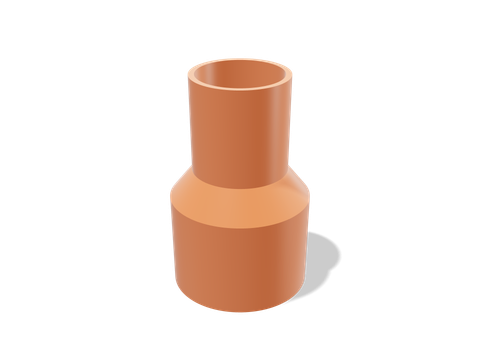 Dust hose adapterTwo measured diameters in, a tapered friction-fit adapter out. Inside or over at each end.58 × 58 × 92 mm · 31 g · 52 min
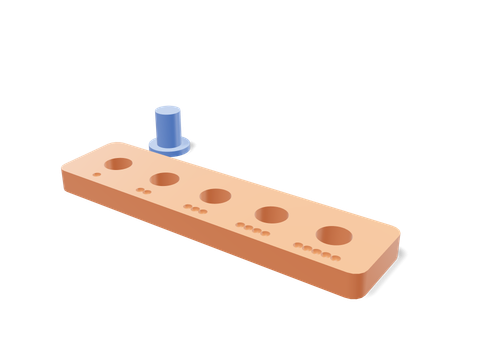 Tolerance testerNot sure how small your printer makes a bore? Twenty minutes of printing answers it for the filament you will use.71 × 35 × 10 mm · 5 g · 21 min
Questions people ask
What size is a 2-1/2 inch shop vac hose really?
About 63.5 mm across the hose body, which touches nothing. The cuff on its end and the vac inlet it plugs into are 2-1/4 in, 57.2 mm outside with about a 52.4 mm bore. Powertec’s measured “2-1/2 in” reducer end is 62.7 mm outside and 57.9 mm inside, so measure yours.
How much clearance does a 3D printed hose adapter need?
Loftsmith’s generator starts a cuff 0.4 mm loose (on the diameter) at the tip and tightens it by 0.8 mm over a 40 mm cuff, so the hose slides on and then jams. If it is loose, raise the taper by 0.2 mm; if it will not start, raise the clearance by 0.2 mm. Printed bores come out a little small, so a tolerance test in your filament settles it.
Does the adapter go inside the hose or over it?
It depends on the end. A vac end usually goes inside the hose cuff, so it is sized by the cuff’s inside diameter; a tool end usually goes over a spigot, so it is sized by the spigot’s outside diameter. Decide for each end before you measure, and measure a few millimetres in from the opening, because cuffs and moulded ports are tapered.
Is PLA OK for a dust collection adapter?
On a bench, yes. PETG is the better default: it bends before it cracks when a hose is yanked and does not soften next to a warm motor or in a hot van. Print three walls so a large cuff is solid wall; below about 2 mm it can split when a stiff hose is twisted on.
Does a printed adapter need to be anti-static?
A PLA or PETG adapter is an insulator, so it breaks a grounded hose run. On a short shop vac hose to a sander that is a comfort issue; on a 4 in system feeding a collector, keep the hose’s ground wire continuous through or around the adapter, as duct makers tell you to ground the system.
Sources and method
Written by the Loftsmith team. The hose, cuff and port sizes are the sellers’ own published figures (Rockler, Oneida, Powertec, Bosch, Festool, Makita, DeWalt; two dealer listings for the Festool D 27 and Makita 28 mm inside-and-outside pairs), read on 9 November 2026 from the pages listed below, with fractions of an inch converted at 25.4 mm. They are not engine data, and nominal sizes vary by a few tenths of a millimetre between makers.
The clearance, taper, cuff length, wall and 45-degree cone limit are the defaults of Loftsmith’s hose adapter generator; a test keeps this guide and the generator in step. No hoses were measured for this article: measure yours.
Not settled: no maker publishes the outside diameter of a “1-7/8 in” or “1-1/4 in” hose cuff, the outside diameter of 4 in flex hose, or the DeWalt DWS780 port size, so the chart leaves those blank rather than guess.
Found a mistake? Email [email protected] and we’ll fix it.
- Rockler: Measuring dust ports and dust hoses
- Oneida Air: 2 in to 2.25 in plastic vacuum hose adapter
- Rockler: shop vac dust fitting adapter, 1-1/4 to 2-1/4 in
- Powertec 70136: 4 in to 2-1/2 in cone reducer (measured dimensions)
- Rockler: router table dust port
- Rockler: Dust Right universal small port hose kit
- Rockler: Dust Right 4 in anti-static dust hose
- Bosch VAC005 35 mm hose
- Bosch VAC020 hose (2-1/4 in vac end, 1-3/8 in tool end)
- Festool D 36/32 x 3.5 m AS/R suction hose
- Festool D 36 x 5 m AS/CTR suction hose
- Festool D 27/32 x 3.5 m AS/90 hose (dealer listing with inner and outer diameters)
- Makita 195433-3 28 mm hose (dealer listing with inner and outer diameters)
- Makita VC002GL specification (28 and 38 mm hoses)
- DeWalt DW735 planer manual (4 in dust port)
- DeWalt DWV9140 tapered adapter (55 to 60 mm ports)
- DeWalt DWV9130 35 mm tool adapter
- Fine Woodworking: 3D printed dust collection accessories (2024)
- Becky Stern: 3D printed dust port adapter
- McMaster-Carr: dust collection duct (grounding)