Folding phone tripod with a print-in-place ball head
A pocket tripod for your phone. The hub, all three legs and the ball head print flat as one piece, already hinged: the legs fold side by side for your pocket and swing open until printed stops catch them at about 30 degrees. The ball sits captured in the hub and a small side knob locks your aim. The clamp prints separately with its sliding top jaw already in place, twists onto the ball head in landscape or portrait, and a printed thumb screw pushes the jaw down onto the phone. The checks prove every body prints free, the legs stop where they should, the ball can't fall out, phones from 65 to 85 mm wide (8 to 16 mm thick) go in and stay held, and the centre of mass stays inside the feet in both orientations with a 230 g phone.
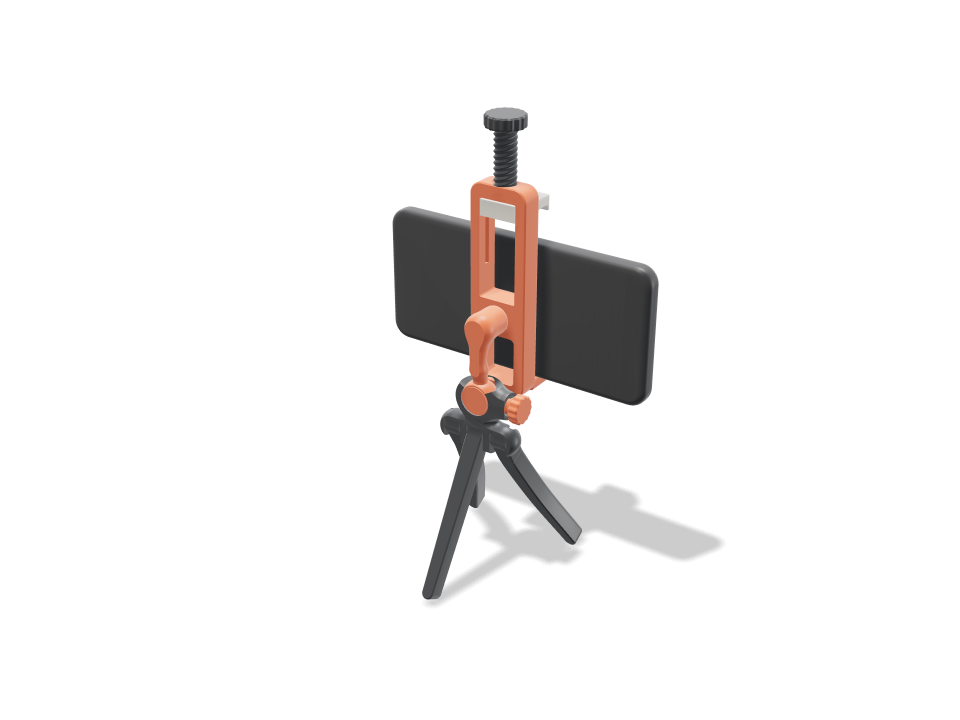
Ask for the sizes you want to tweak, e.g. “make the width adjustable”.
Specs at the default size
Measured from the actual build on a Bambu Lab A1 in pla. Every number updates live when you drag a slider above.
- Overall size
- 75 × 57 × 265 mm
- Parts
- 9
- Filament
- 51 g
- Print time
- 2 h 4 min
- Build plates
- 1
- Supports
- None needed
Engineering checks
- Hub, legs and ball head start on the bedall flat-backed at y = -5.5 (the print bed); legs, hub and ball flat print side by side
- Every body prints freeworst overlap 0.000 mm³ with a 0.4 mm gap
- Legs open to a hard stopfree at 30/30/30 deg; 3 deg further the cheek bosses bite the groove ends (1.4, 1.3, 1.4 mm³)
- Legs fold flat and stop therethe same bosses stop each leg 3.1 deg past flat, so the pack stays flat in a pocket
- Legs splay about 30 deg32.0 / 30.0 / 32.0 deg from vertical
- Stop bosses take the load2.6 MPa shear per 3 mm boss (19 N each, 4.3 N per foot with a 10 N press); allowed 5.0 across layers
- Legs are stiff enough1.0 MPa at the leg root (205 N mm); PLA allows 16.7 along the layers
- Ball is captureda 2.5 mm push in any of 6 directions hits the socket (39.4 mm³ min); openings 14.7 mm front, 17.7 mm back for a 20 mm ball (1.2 mm lip)
- Tilt conethe 8 mm stem leans 32 deg to either side before it meets the socket rim (5 deg more is blocked); pans all the way round
- Nods 25 deg up and down with the clamp onhead and clamp clear of the hub and legs at +/-25 deg (0.00 / 0.00 mm³); the socket is open front and back for printing, so the lock knob, not a rim, sets the nod
- Lock knob threads in cleanprinted screw vs its threaded bore: 0.000 mm³ at rest, 0.3 mm radial thread clearance
- Lock knob holds the aima 0.15 N m finger twist pushes 63 N on the ball: ~0.31 N m of grip vs 0.09 N m from a 250 g phone (estimate, friction 0.25)
- Widest, thickest phone fits85 x 16 mm: lifted 3.6 mm over the lower hook it still has 1.4 mm under the open top hook and 1.0 mm in front, and slides out clear
- Narrowest, thinnest phone is held65 x 8 mm: the jaw reaches it; 3 mm hooks lap both edges (2 mm net of a 1 mm edge round), so tipping it 15 deg or pulling it forward hits them (50 mm³)
- Thumb screw holds its griplead angle 14.2 deg vs friction angle 16 deg on 45 deg flanks: it cannot back off by itself
- Top bridge takes the squeeze1.4 MPa in the bridge for a 40 N squeeze; 16.7 allowed
- Clamp twists on and locksturned 45 deg it slides on and off the peg clear (14 poses, worst 0.00 mm³); level or turned to portrait the lugs sit behind the bore lip, so a pull hits them (15.3 / 15.3 mm³)
- Stands steady in landscapecentre of mass 15 mm inside the feet, 143 mm up: tips only past 6 deg (230 g, 85 x 175 mm phone)
- Stands steady in portraitcentre of mass 15 mm inside the feet, 136 mm up: tips only past 6 deg
- tripod stays together after printingall 5 bodies are captive: none can be pulled out along any axis
- tripod is held firmlyevery captive body is held by at least 0.8 mm (two perimeters)
- clamp stays together after printingall 2 bodies are captive: none can be pulled out along any axis
- clamp is held firmlyevery captive body is held by at least 0.8 mm (two perimeters)
- phone goes in25 poses along its path clear of every part.
Adjustable sizes
| Setting | Default | Range |
|---|---|---|
| Leg length | 95 mm | 85–120 mm |
| Narrowest phone | 65 mm | 60–70 mm |
| Widest phone | 85 mm | 78–88 mm |
| Ball diameter | 20 mm | 18–22 mm |
| Print-in-place gap | 0.4 mm | 0.3–0.6 mm |
Parts list
| Part | Qty | Size (mm) | Filament | Time |
|---|---|---|---|---|
| hub | 1 | 49 × 40 × 17 | 6 g | 13 min |
| leg 1 | 1 | 28 × 101 × 12 | 5 g | 12 min |
| leg 2 | 1 | 10 × 101 × 12 | 5 g | 12 min |
| leg 3 | 1 | 28 × 101 × 12 | 5 g | 12 min |
| ball head | 1 | 20 × 58 × 35 | 5 g | 14 min |
| lock knob | 1 | 16 × 16 × 17 | 1 g | 7 min |
| clamp | 1 | 34 × 118 × 34 | 18 g | 30 min |
| clamp jaw | 1 | 24 × 12 × 34 | 3 g | 11 min |
| clamp screw | 1 | 22 × 22 × 44 | 3 g | 13 min |
How to make it
- Set the leg length, the narrowest and widest phone you use, and the ball size. Leave the print-in-place gap at 0.4 mm unless your printer runs tight or loose.
- Print the tripod piece flat on its back and the clamp piece flat on its back, then the lock knob and the thumb screw standing on their knobs.
- Snap the printed parts free with a gentle twist of each leg and the ball, screw the lock knob into the side of the hub and the thumb screw into the top of the clamp.
- Turn the clamp 45 degrees, push it onto the ball head's peg and turn it level for landscape or a further quarter turn for portrait. Lift the top jaw, drop the phone in and turn the thumb screw down.
Print tips
- PLA with 3-4 walls is fine; print the tripod and clamp with no supports and the back face on the bed so every hinge and slide keeps its gap.
- If the hinges or the ball feel stuck after printing, work them gently back and forth a few times before standing the tripod up. If they are loose, print again with a smaller gap.
- The threads are coarse 45 degree threads; print the screws at 0.2 mm layers or finer so they run smoothly.
FAQ
Does it need any screws or other hardware?
No. Everything is printed: the hinge pins, the stops, the ball joint, both thumb screws and the bayonet that holds the clamp.
Will it hold my phone in a case?
The clamp takes phones 65 to 85 mm wide and up to 16 mm thick, which covers most phones in a slim case. Set the widest-phone slider to your phone with its case on.
How stable is it?
With a large 230 g phone the centre of mass stays about 15 mm inside the feet in landscape and portrait on the default 95 mm legs. It's a table tripod, so stand it on a flat surface and keep it out of the wind.
Need a shape that isn't in the catalog? Describe it in your own words with text to CAD
Comments