Klappbares Handystativ mit Print-in-Place-Kugelkopf
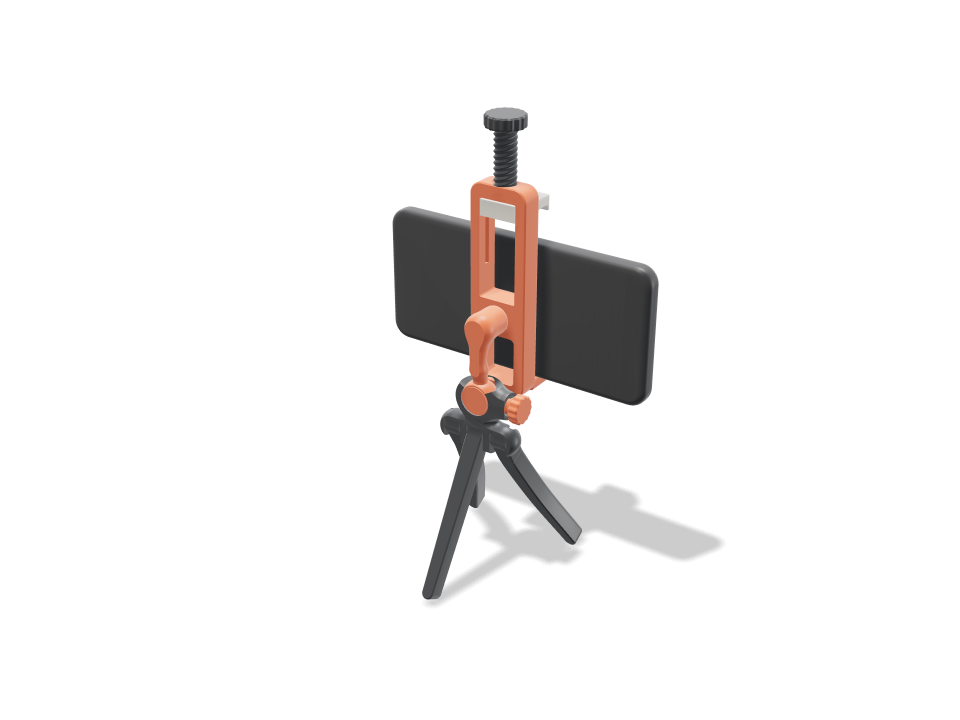
Ein Taschenstativ für dein Handy. Nabe, alle drei Beine und der Kugelkopf werden flach als ein Teil gedruckt, schon mit Scharnieren: Die Beine klappen für die Tasche nebeneinander und schwenken auf, bis gedruckte Anschläge sie bei etwa 30 Grad abfangen. Die Kugel sitzt gefangen in der Nabe, und ein kleiner seitlicher Knauf fixiert deine Ausrichtung. Die Klemme wird separat gedruckt, ihre verschiebbare obere Backe schon an Ort und Stelle; sie wird quer oder hochkant auf den Kugelkopf gedreht, und eine gedruckte Rändelschraube drückt die Backe auf das Handy. Die Prüfungen belegen, dass jeder Körper frei gedruckt wird, dass die Beine dort stoppen, wo sie sollen, dass die Kugel nicht herausfallen kann, dass Handys von 65 bis 85 mm Breite (8 bis 16 mm dick) hineinpassen und gehalten werden und dass der Schwerpunkt mit einem 230-g-Handy in beiden Ausrichtungen innerhalb der Füße bleibt.
Ask for the sizes you want to tweak, e.g. “make the width adjustable”.
Daten bei Standardgröße
Gemessen am echten Build auf einem Bambu Lab A1 in pla. Jede Zahl aktualisiert sich live, wenn du oben an einem Regler ziehst.
- Gesamtgröße
- 75 × 57 × 265 mm
- Teile
- 9
- Filament
- 51 g
- Druckzeit
- 2 h 4 min
- Druckplatten
- 1
- Stützstrukturen
- Nicht nötig
Technische Prüfungen
Namen von Prüfungen und Parametern kommen direkt aus der CAD-Engine und sind auf Englisch.
- Hub, legs and ball head start on the bedall flat-backed at y = -5.5 (the print bed); legs, hub and ball flat print side by side
- Every body prints freeworst overlap 0.000 mm³ with a 0.4 mm gap
- Legs open to a hard stopfree at 30/30/30 deg; 3 deg further the cheek bosses bite the groove ends (1.4, 1.3, 1.4 mm³)
- Legs fold flat and stop therethe same bosses stop each leg 3.1 deg past flat, so the pack stays flat in a pocket
- Legs splay about 30 deg32.0 / 30.0 / 32.0 deg from vertical
- Stop bosses take the load2.6 MPa shear per 3 mm boss (19 N each, 4.3 N per foot with a 10 N press); allowed 5.0 across layers
- Legs are stiff enough1.0 MPa at the leg root (205 N mm); PLA allows 16.7 along the layers
- Ball is captureda 2.5 mm push in any of 6 directions hits the socket (39.4 mm³ min); openings 14.7 mm front, 17.7 mm back for a 20 mm ball (1.2 mm lip)
- Tilt conethe 8 mm stem leans 32 deg to either side before it meets the socket rim (5 deg more is blocked); pans all the way round
- Nods 25 deg up and down with the clamp onhead and clamp clear of the hub and legs at +/-25 deg (0.00 / 0.00 mm³); the socket is open front and back for printing, so the lock knob, not a rim, sets the nod
- Lock knob threads in cleanprinted screw vs its threaded bore: 0.000 mm³ at rest, 0.3 mm radial thread clearance
- Lock knob holds the aima 0.15 N m finger twist pushes 63 N on the ball: ~0.31 N m of grip vs 0.09 N m from a 250 g phone (estimate, friction 0.25)
- Widest, thickest phone fits85 x 16 mm: lifted 3.6 mm over the lower hook it still has 1.4 mm under the open top hook and 1.0 mm in front, and slides out clear
- Narrowest, thinnest phone is held65 x 8 mm: the jaw reaches it; 3 mm hooks lap both edges (2 mm net of a 1 mm edge round), so tipping it 15 deg or pulling it forward hits them (50 mm³)
- Thumb screw holds its griplead angle 14.2 deg vs friction angle 16 deg on 45 deg flanks: it cannot back off by itself
- Top bridge takes the squeeze1.4 MPa in the bridge for a 40 N squeeze; 16.7 allowed
- Clamp twists on and locksturned 45 deg it slides on and off the peg clear (14 poses, worst 0.00 mm³); level or turned to portrait the lugs sit behind the bore lip, so a pull hits them (15.3 / 15.3 mm³)
- Stands steady in landscapecentre of mass 15 mm inside the feet, 143 mm up: tips only past 6 deg (230 g, 85 x 175 mm phone)
- Stands steady in portraitcentre of mass 15 mm inside the feet, 136 mm up: tips only past 6 deg
- tripod stays together after printingall 5 bodies are captive: none can be pulled out along any axis
- tripod is held firmlyevery captive body is held by at least 0.8 mm (two perimeters)
- clamp stays together after printingall 2 bodies are captive: none can be pulled out along any axis
- clamp is held firmlyevery captive body is held by at least 0.8 mm (two perimeters)
- phone goes in25 poses along its path clear of every part.
Anpassbare Maße
| Einstellung | Standard | Bereich |
|---|---|---|
| Leg length | 95 mm | 85–120 mm |
| Narrowest phone | 65 mm | 60–70 mm |
| Widest phone | 85 mm | 78–88 mm |
| Ball diameter | 20 mm | 18–22 mm |
| Print-in-place gap | 0.4 mm | 0.3–0.6 mm |
Teileliste
| Teil | Anz. | Größe (mm) | Filament | Zeit |
|---|---|---|---|---|
| hub | 1 | 49 × 40 × 17 | 6 g | 13 min |
| leg 1 | 1 | 28 × 101 × 12 | 5 g | 12 min |
| leg 2 | 1 | 10 × 101 × 12 | 5 g | 12 min |
| leg 3 | 1 | 28 × 101 × 12 | 5 g | 12 min |
| ball head | 1 | 20 × 58 × 35 | 5 g | 14 min |
| lock knob | 1 | 16 × 16 × 17 | 1 g | 7 min |
| clamp | 1 | 34 × 118 × 34 | 18 g | 30 min |
| clamp jaw | 1 | 24 × 12 × 34 | 3 g | 11 min |
| clamp screw | 1 | 22 × 22 × 44 | 3 g | 13 min |
So wird’s gemacht
- Stell die Beinlänge, das schmalste und das breiteste Handy, das du nutzt, und die Kugelgröße ein. Lass das Print-in-Place-Spiel auf 0,4 mm, außer dein Drucker druckt eng oder locker.
- Druck das Stativteil flach auf dem Rücken und das Klemmenteil flach auf dem Rücken, dann den Feststellknauf und die Rändelschraube auf ihren Köpfen stehend.
- Lös die gedruckten Teile mit einem sanften Dreh an jedem Bein und an der Kugel, schraub den Feststellknauf seitlich in die Nabe und die Rändelschraube oben in die Klemme.
- Dreh die Klemme um 45 Grad, drück sie auf den Zapfen des Kugelkopfs und dreh sie waagerecht für Querformat oder eine weitere Vierteldrehung für Hochformat. Heb die obere Backe an, setz das Handy ein und dreh die Rändelschraube herunter.
Drucktipps
- PLA mit 3–4 Wänden reicht; druck Stativ und Klemme ohne Stützen und mit der Rückseite auf dem Bett, damit jedes Scharnier und jede Führung ihr Spiel behält.
- Wenn Scharniere oder Kugel nach dem Druck festsitzen, beweg sie ein paar Mal vorsichtig hin und her, bevor du das Stativ aufstellst. Sind sie locker, druck noch einmal mit kleinerem Spiel.
- Die Gewinde sind grobe 45-Grad-Gewinde; druck die Schrauben mit 0,2 mm Schichten oder feiner, damit sie leicht laufen.
Häufige Fragen
Braucht es Schrauben oder andere Hardware?
Nein. Alles ist gedruckt: die Scharnierstifte, die Anschläge, das Kugelgelenk, beide Rändelschrauben und das Bajonett, das die Klemme hält.
Hält es mein Handy mit Hülle?
Die Klemme nimmt Handys mit 65 bis 85 mm Breite und bis 16 mm Dicke, das deckt die meisten Handys in einer schlanken Hülle ab. Stell den Regler für das breiteste Handy auf dein Handy mit Hülle ein.
Wie stabil ist es?
Mit einem großen 230-g-Handy bleibt der Schwerpunkt bei den Standardbeinen von 95 mm quer und hochkant etwa 15 mm innerhalb der Füße. Es ist ein Tischstativ, also stell es auf eine ebene Fläche und halt es aus dem Wind.
Du brauchst eine Form, die nicht im Katalog ist? Beschreib sie in deinen eigenen Worten mit Text zu CAD
Comments