Dust collection hose adapter generator
Every tool port and every hose is a different size, and the size on the label is rarely the size you measure. Give each end the diameter you measured and say whether it slides into or over the hose; the cuff starts loose by the clearance and tightens by the taper, so the hose jams on and stays. The checks confirm the taper grips without splitting the hose, the cone between the two ends prints without supports, the bore keeps most of the smaller hose's airflow and the walls take a hose being twisted on.
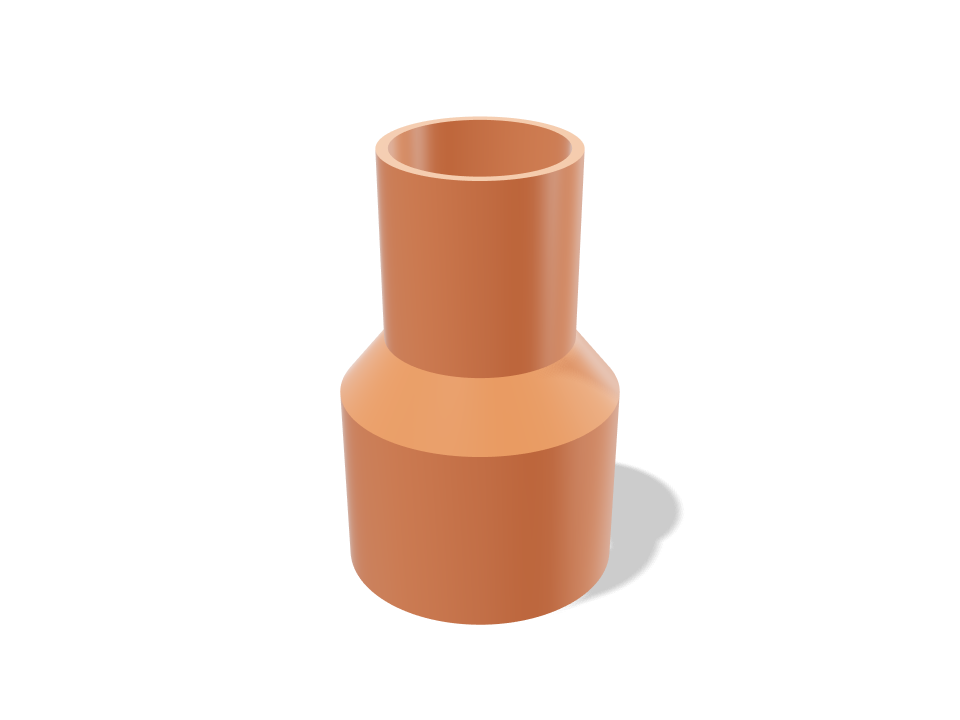
Ask for the sizes you want to tweak, e.g. “make the width adjustable”.
Caractéristiques à la taille par défaut
Mesuré sur la génération réelle, sur une Bambu Lab A1 en PETG. Chaque chiffre se met à jour en direct quand vous bougez un curseur plus haut.
- Encombrement
- 58 × 58 × 92 mm
- Pièces
- 1
- Filament
- 31 g
- Temps d’impression
- 52 min
- Plateaux
- 1
- Supports
- Aucun
Vérifications d’ingénierie
Les noms des vérifications et des paramètres viennent du moteur de CAO et sont affichés en anglais.
- Hose jams on the taper0.8 mm over each cuff (0.4 to 2 mm grips without splitting the hose)
- Cone prints without supports38 deg from vertical over 12 mm
- Airflow kept through the bore34.6 mm narrowest bore, 98% of the smaller hose's area
- Walls hold a hose being twisted on2.4 mm walls
Dimensions réglables
| Paramètre | Par défaut | Plage |
|---|---|---|
| End A: measured hose or port diameter | 58 mm | 20–130 mm |
| End A slides inside the hose or port | oui | oui / non |
| End A cuff length | 40 mm | 20–80 mm |
| End B: measured hose or port diameter | 35 mm | 20–130 mm |
| End B slides inside the hose or port | non | oui / non |
| End B cuff length | 40 mm | 20–80 mm |
| Wall thickness | 2.4 mm | 1.6–4 mm |
| Clearance at the tip (diameter) | 0.4 mm | 0–1.5 mm |
| Taper over each cuff (diameter) | 0.8 mm | 0–2.5 mm |
Comment la réaliser
- Measure the inside or outside of each hose or port with calipers, not the label.
- Set both diameters, tick which ends slide inside, and set each cuff length.
- Print standing on the wider end, 3 walls, no supports; if a cuff is loose, raise Taper by 0.2 mm.
Conseils d’impression
- PETG or PLA, 0.2 mm layers, 3 walls, 0 to 10% infill: the part is all wall.
- Stand it on its wider end; the cone leans less than 45 degrees so it needs no supports.
- Ribbed and flexible hoses stretch, so they take a bigger taper than a rigid tool port.
FAQ
Which size do I type: inside or outside diameter?
The size of the surface the adapter touches. For an end that slides inside a hose, measure the hose's inside diameter; for an end that slips over a port, measure the port's outside diameter. Then tick the inside box to match.
Why is the cuff tapered?
A straight cuff is either loose or impossible to push on. A taper of about 0.8 mm over the cuff starts loose and tightens as the hose goes home, so it jams by friction and pulls off again by hand.
Does it need supports?
No. The cone between the two ends is kept at 45 degrees or less from vertical, and the checks tell you if a setting breaks that.
Besoin d’une forme qui n’est pas dans le catalogue ? Décrivez-la avec vos mots grâce au texte vers CAO
Comments