An automatic chicken feeder Loftsmith designed from one prompt
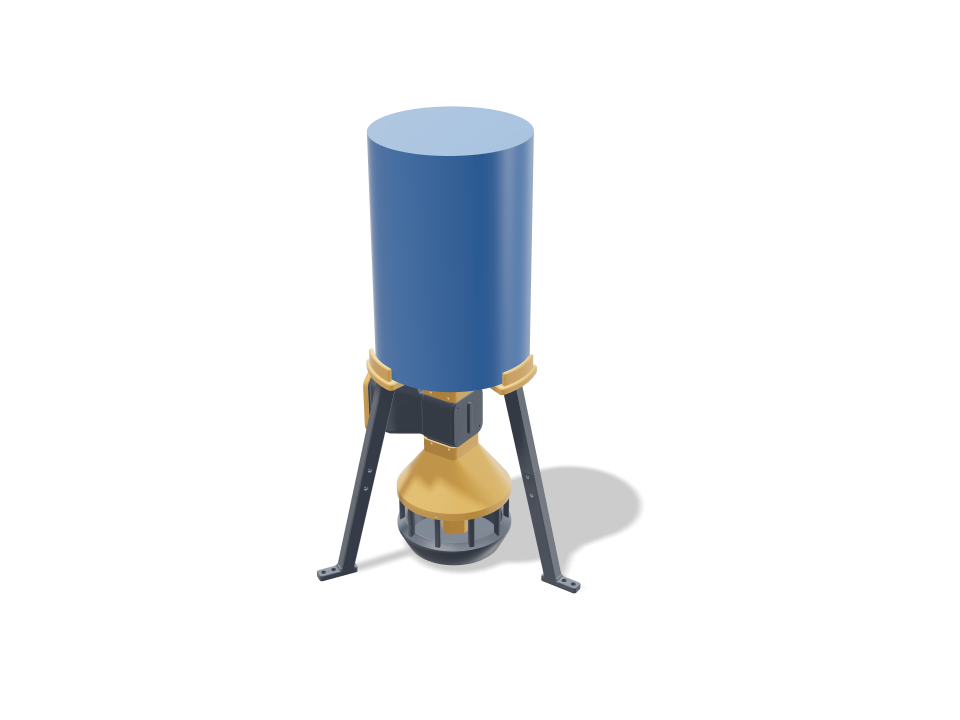
Nobody drew this either. We gave Loftsmith one paragraph: an automatic feeder for layer pellets, using a bought 30 L open-top drum as the hopper and a NEMA 23 stepper to meter the feed, standing outdoors in a chicken run. It planned the build in five stages and designed it on its own. A 90 mm hole in the drum floor feeds a steep 69° funnel that is too wide for pellets to bridge. Below that, a six-pocket rotary valve drops about 29 g per 60° step, with vanes skewed 15° so they shear through pellets instead of jamming on them. The feed falls into a covered pan that stops filling once the pile covers the chute. Bars keep heads in and feet out, and a smooth hood gives hens nowhere to perch. The motor, DM542 driver, ESP32 and buck converter share one gasketed pod, and a three-leg stand holds the drum at head height. Two thumb-screws open the valve to clear a jam. What you see here is exactly what it made, unedited, including its own notes.
Feito por Loftsmith a partir de um só prompt
“Design an automated chicken feeder that dispenses dry layer pellets at set feeding times. The hopper is a small 30 L UN-approved open-top plastic keg drum (about 310 mm diameter and 470 mm tall, with a clamp-ring lid); design around a drum you'd buy, not a printed one. Feed is metered by a NEMA 23 stepper motor (57 mm square flange, 47.14 mm bolt pattern for M5 screws, 38.1 mm centring boss, 6.35 mm shaft) turning a printed auger or rotary valve, so each run drops a measured portion into a tray or trough the chickens can reach but can't scratch the feed out of or roost on. The drum outlet must not bridge or jam with pellets, and the motor and its driver/controller (for example an ESP32 with a DM542-type driver) must be kept dry and away from beaks. It stands outdoors in a run, so use PETG, give rain and rodents no easy way in, and make it easy to refill and to clear a jam. Show how everything mounts and is fastened, and split any part that doesn't fit the bed.”
Isto é exatamente o que Loftsmith projetou a partir do prompt abaixo, sem edição: planejou o projeto, escreveu e reconstruiu o modelo conforme as verificações voltavam, e terminou sozinho.
- Turnos de design
- 15
- Builds (12 aprovados)
- 12
- Tokens (entrada / saída)
- 1.14M / 0.27M
- Créditos Loftsmith
- 119
- Verificações de engenharia aprovadas
- 58
Projetado em 2026-09-28. Nos preços do plano Pro, 119 créditos saem por cerca de US$ 24.
Ask for the sizes you want to tweak, e.g. “make the width adjustable”.
Especificações no tamanho padrão
Medido na geração real em uma Bambu Lab A1 com PETG. Cada número se atualiza ao vivo quando você arrasta um controle acima.
- Tamanho total
- 489 × 547 × 478 mm
- Peças
- 17
- Filamento
- 1783 g
- Tempo de impressão
- 40 h 26 min
- Placas
- 8
- Suportes
- Não precisa
Verificações de engenharia
Os nomes das verificações e dos parâmetros vêm do motor de CAD e aparecem em inglês.
- Funnel steep enough to self-emptyshallowest wall 68.7 deg from horizontal (pellets slide above ~35-40 deg)
- Throat won't bridgenarrowest opening 50 mm = 12.5x pellet size (>= 8x)
- Rotor gap too small to trap pellets0.6 mm per side vs 4 mm pellets; rotor envelope overlap 0.00 mm3
- Housing wall7.4 mm at the flats around the bore
- Motor seats flatboss in a 38.7 mm spigot, flange on the end face
- Funnel sits on the neck0.4 mm per side slip socket locked by 4x M5, 18 mm skirt overlap; overlap 0.00 mm3
- Portion per 60 deg step47 cm3 pocket = about 29 g of layer pellets (0.62 g/cm3 bulk)
- Skirt bolts hold the hanging valve + motor25 N per M5 in shear (bumped x2, 0.94 kg motor 86 mm out); skirt bearing 0.9 MPa vs 5.0 across layers
- Drum inserts hold funnel + valve + motor7 N pull per M5 insert (bumped x2) vs ~1000 N typical M5 heat-set pull-out in PETG, derated to 300
- Vane survives a stalled pinch5.1 MPa at the 7 mm vane root (full 1.2 N.m motor torque on one pellet, 20 mm of vane) vs 16.7 along layers; the motor stalls first, firmware reverses
- D-flat drives the rotor8.5 MPa bearing on 15 mm of shaft flat at 1.2 N.m vs 16.7 along layers
- Rotor slides onto the motor shaftD-bore 0.15 mm clear of the shaft and its flat; overlap 0.00 mm3
- Hatch clears the funnel skirt0.6 mm gap under the skirt; hatch still covers the 91.2 mm bore
- Shaft engagement18.5 mm of the 21 mm shaft inside the rotor hub
- Rotor floats clear of hatch and end wall0.6 mm end gaps; hatch overlap 0.00 mm3; hub 2.35 mm clear of the spigot hole, 0.9 mm off the motor boss
- Roost-cap slips onto the valve neck0.4 mm per side socket, 4x M5 through the collar; overlap with housing/hatch/trough/motor 0.00 mm3
- Hood too steep to perch onshallowest hood slope 46.0 deg, smooth, no ledge wider than the 3 mm skirt
- Portion stays in the panpellets settle at ~32 deg into a 133 mm pile on the 196 mm floor
- Chute seals itselfthe pile holds 179 cm3 = 3.8 portions, then covers the chute mouth: over-dispensing just leaves the pockets full
- Hens eat but can't climb in or scratch10 bars, 58 x 70 mm head windows (a hen is ~150 mm across); feet can't reach the feed
- Billing-out liprim returns 14.2 mm inward on a 45 deg underside, 3.5 mm thick at the tip, so flicked pellets fall back in
- Hood keeps rain off the feedskirt drips at r 121 onto the outward-sloping rim, outside the 234 mm feed opening
- Collar holds the hung trough20 N per M5 (1.49 kg hung x2 + a landing hen); tear-out above each hole 1.4 MPa vs 5.0
- Trough screws26 N per M4 insert in a bar end (~800 N typical pull-out, derated to 200)
- Bars carry the pan across their layers0.28 MPa in a screwed bar at the insert vs 5.0 across layers
- Funnel skirt bolts with everything hung45 N per M5; bearing 1.6 MPa vs 5.0
- Pod fits round the motor, clear of funnel and roost-cap57 mm motor flange passes a 61.4 mm throat; overlap 0.00 mm3 with every neighbour
- Pod prints without supportsinside roof closes from the full box to the 61.4 mm motor throat at 40.5 deg from vertical over 84 mm (lid face down)
- Pod roof clears the funnel skirtroof stays at 49 mm (skirt starts at 52 mm) until x -54.6, 6.8 mm behind the skirt edge
- Electronics fit on the lidDM542 10 mm behind the motor's rear cap, ESP32 in the roof, buck under the driver; overlap 0.00 mm3
- Nothing to perch onridge 18 mm under the drum floor (a hen needs ~300 mm); the 23 mm past the drum rim is a 46 deg roof
- Supply lead exits low at the backPG7 gland in the lid 12 mm above the pod floor, lead turns down in a 30 mm drip loop (5x its 6 mm size); overlap 0.00 mm3
- Pod screws hold the pod17 N pull on the top M4 insert (1.24 kg pod + electronics bumped x2, 54 mm out) vs ~800 N typical pull-out, derated to 200
- Funnel skirt bolts with the pod added78 N per M5; bearing 2.8 MPa vs 5.0
- Stand clears the valve, trough and podall three legs and saddles vs every part and the motor: overlap 0.00 mm3
- Drum sits in the saddlesrim on three 56 mm lands inside 28 mm lips, 4 mm clear of the 310 mm drum (1.5 mm at the root fillet); one M5 per saddle through the floor; overlap 0.00 mm3
- Trough screws reachable between the legsnearest screw 24 deg from a leg: a driver passes 58 mm clear
- Jam hatch and rotor still come outnearest leg 11.5 mm beyond the fully pulled rotor
- Stands steady full, even unstakedfull (27.8 kg, CG 597 mm up) needs a 58 N sideways shove to tip
- Staked feet hold it empty in a 72 km/h gustempty (9.2 kg): 61 N wind lifts the windward foot with 49 N vs two 10 mm stakes (~100 N each, derated) and the saddle's drum-bolt insert (300)
- Legs won't buckle188 N per leg (full, set down x2) vs 1498 N Euler limit, conservatively top-free (K = 2)
- Splice takes a sideways kick40 N kick mid-leg: 5.7 MPa in the 13 mm lap, 1.5 MPa bolt bearing vs 16.7 along layers; 64 mm lap
- Saddle wings carry the drum1.3 MPa in each wing (full drum set down x2) vs 16.7
- NEMA 23 motor goes in20 poses along its path clear of every part.
- driver: hatch thumb-screw goes in20 poses along its path clear of every part.
- driver: motor M5 goes in15 poses along its path clear of every part.
- driver: skirt M5 goes in15 poses along its path clear of every part.
- driver: drum M5 (from inside drum) goes in20 poses along its path clear of every part.
- driver: collar M5 goes in15 poses along its path clear of every part.
- driver: trough M4 @36 deg goes in21 poses along its path clear of every part.
- driver: trough M4 @144 deg goes in20 poses along its path clear of every part.
- driver: trough M4 @288 deg goes in20 poses along its path clear of every part.
- DM542 driver goes in20 poses along its path clear of every part.
- ESP32 devkit goes in30 poses along its path clear of every part.
- driver: pod M4 (lid off) goes in30 poses along its path clear of every part.
- driver: lid M3 goes in20 poses along its path clear of every part.
- driver: saddle M5 (before the drum goes on) goes in30 poses along its path clear of every part.
- driver: splice M5 goes in20 poses along its path clear of every part.
Medidas ajustáveis
| Parâmetro | Padrão | Faixa |
|---|---|---|
| Hole sawn in drum floor | 90 mm | 76–110 mm |
| Funnel height | 54 mm | 44–80 mm |
| Rotor clearance (per side) | 0.6 mm | 0.3–1.2 mm |
| Pellet size | 4 mm | 2–6 mm |
| NEMA 23 body length | 76 mm | 41–112 mm |
| Vane skew (scissor cut) | 15 deg | 0–30 deg |
| Head gap between bars | 55 mm | 45–70 mm |
| Chute mouth above pan floor | 25 mm | 15–40 mm |
| Driver mounting holes, long pitch (measure yours) | 112 mm | 90–114 mm |
| Driver mounting holes, short pitch | 64 mm | 40–70 mm |
| Foot radius (wider = steadier) | 253 mm | 230–280 mm |
Lista de peças
| Peça | Qtd. | Tamanho (mm) | Filamento | Tempo |
|---|---|---|---|---|
| valve-housing | 1 | 132 × 106 × 73 | 153 g | 3 h 25 min |
| funnel-adapter | 1 | 152 × 152 × 78 | 128 g | 2 h 53 min |
| valve-rotor | 1 | 88 × 90 × 70 | 49 g | 1 h 13 min |
| jam-hatch | 1 | 104 × 106 × 14 | 38 g | 54 min |
| roost-cap | 1 | 242 × 242 × 229 | 362 g | 8 h 5 min |
| trough | 1 | 244 × 244 × 137 | 257 g | 5 h 43 min |
| electronics-pod | 1 | 181 × 142 × 129 | 225 g | 5 h 2 min |
| pod-lid | 1 | 188 × 149 × 14 | 77 g | 1 h 43 min |
| cradle-segment | 3 | 62 × 125 × 42 | 41 g | 59 min |
| leg | 3 | 97 × 250 × 26 | 61 g | 1 h 23 min |
| foot | 3 | 139 × 250 × 26 | 63 g | 1 h 27 min |
Como fazer
- Saw a 90 mm hole in the centre of the drum floor, then drill the six funnel bolt holes and three saddle bolt holes the model marks.
- Press in the heat-set inserts and nuts, then build the three legs: bolt each foot to its leg through the half-lap, and screw a cradle segment on top.
- Bolt the NEMA 23 and the electronics pod to the valve housing, and bolt the funnel to the drum floor from inside with sealant in its groove.
- Slide the housing into the funnel skirt, fit the rotor on the D-shaft and close the jam hatch with its two thumb-screws.
- Fit the hood and trough, stand the legs 120° apart, set the drum in the saddles and bolt it down, then stake each foot.
- Wire the motor, driver, ESP32 and buck in the pod, bring the 24 V lead in through the PG7 gland with a drip loop, and close the lid.
Dicas de impressão
- Every part is PETG at 0.2 mm, 3 walls and 20% infill, with no supports. Use 4 walls on the legs, feet and cradle segments for extra stiffness.
- Add a brim to the hood and the electronics pod.
- It's a big print: about 1.8 kg of PETG in total.
Perguntas frequentes
Was this really made from one prompt?
Yes. The only input was the prompt on this page, with a Bambu Lab A1 and PETG selected. Loftsmith planned five stages, built the model 12 times as the engineering checks came back (every build worked), and finalised it. The model and the notes on this page are its unedited output.
What did it cost to design?
15 design turns, 1.1 million input tokens and 0.27 million output tokens: 119 Loftsmith credits, about $24 at Pro plan prices. That is under half of the one-prompt flying wing.
What do I need to buy?
The 30 L open-top drum, a NEMA 23 stepper with a 6.35 mm shaft, a DM542 driver, an ESP32 board, a 24 V outdoor power supply with a 24 to 5 V buck converter, a PG7 cable gland, and the M3, M4 and M5 inserts and screws listed in the parts panel.
Comments