Lampada da scrivania pieghevole per un disco LED USB
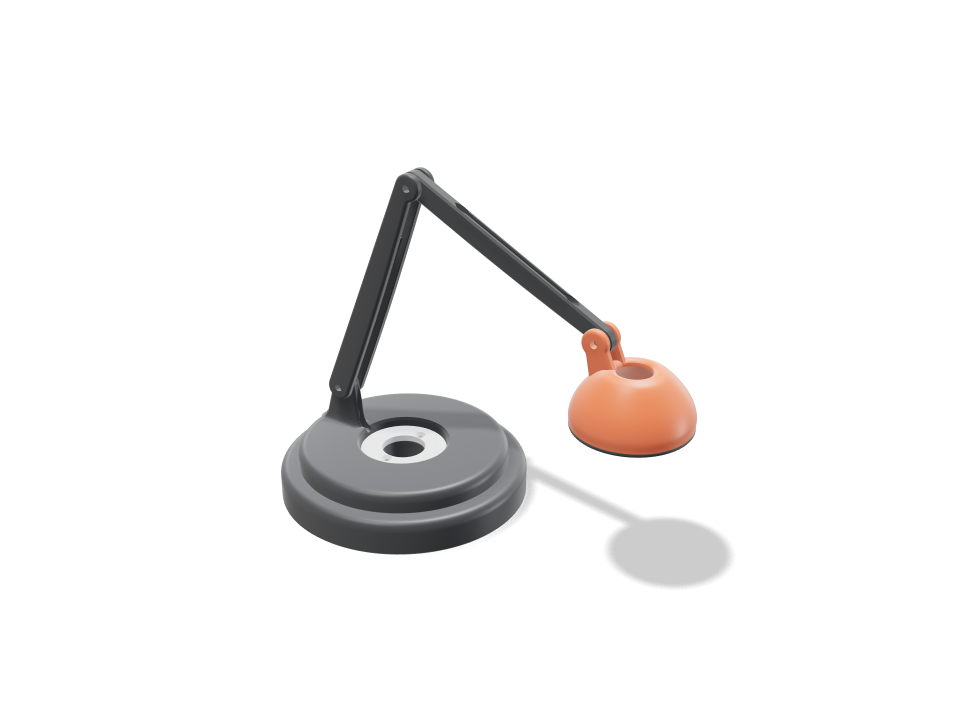
Una lampada da scrivania stile architetto costruita attorno a un economico disco LED USB. Un braccio inferiore a doppia barra e una lama superiore sottile si ripiegano piatti o si allungano, la testa si inclina e tutto il braccio ruota su una torretta che gira sulla base. Ogni snodo è un semplice bullone M4 con rondella elastica e dado autobloccante, quindi resta dove lo lasci. Il cavo USB si incastra in canaline lungo il braccio, gira attorno a ogni snodo ed esce sotto la base, sul retro. I controlli dimostrano che il cavo non si piega mai più stretto di cinque volte il suo spessore in nessuna posizione, che ogni cerniera regge almeno il doppio del peso del braccio alla massima estensione pur muovendosi con una spinta leggera, e che con monete o rondelle nella base la lampada resta in piedi e il braccio cede prima che si ribalti.
Ask for the sizes you want to tweak, e.g. “make the width adjustable”.
Specifiche alla dimensione predefinita
Misurate sulla generazione reale su una Bambu Lab A1 in pla. Ogni numero si aggiorna in tempo reale quando trascini un cursore qui sopra.
- Ingombro
- 280 × 160 × 220 mm
- Pezzi
- 7
- Filamento
- 221 g
- Tempo di stampa
- 5 h 31 min
- Piatti
- 2
- Supporti
- Alcuni pezzi
Controlli ingegneristici
I nomi dei controlli e dei parametri arrivano dal motore CAD e sono mostrati in inglese.
- Lead lies free in its channels in every poseworst overlap 0.00 mm3 over 6 poses
- Lead bends gently in every posetightest bend 17.5 mm = 5.0x the 3.5 mm lead (folded 17.5, rest 17.5, reaching 17.5, rest, head up 75 deg 17.5, reaching, head up 17.5, folded, head up 17.5)
- Fixed run bends gently14.0 mm (4.0x) down the ear, across the turret axis and under the base, where the lead never flexes
- Lead slides to follow the armthe arm run changes 52 mm between poses (373-424 mm); every seat is 1.5 mm wider than the lead and the mouths only stop it falling out, so it slides; leave 80 mm of slack behind the base
- Lead leaves low at the backexits under the base rim at the back, 2.6 mm above the desk
- Puck fits its pocketpocket 60.6 mm for a 60 mm puck; it rests on the 45 degree cone, no contact with the walls
- Puck held by the bezelbezel lip covers 3.0 mm of the puck rim all round; 0.45 mm float between cone and bezel; three M2 screws into heat-set inserts in a 5.6 mm rim
- USB plug threads through the head and the postplug 16.5 x 8.5 mm (18.6 mm across) through a 21 mm apex opening and a 28 mm post bore
- Lead snaps into the arm and stayslower arm: lips leave a 3.0 mm mouth over a 8.4 mm seat; upper arm and ear: a 3.0 mm mouth over a 5.0 mm groove
- Friction hinges hold the arm in every poseshoulder 0.72 N m vs 0.365 N m (x2.0); elbow 0.90 N m vs 0.187 N m (x4.8); head 0.25 N m vs 0.035 N m (x7.2); mu 0.3 PLA on PLA, 6.0 mm mean friction radius, clamp 200/250/70 N
- Moves with a light push3.6 N at the head swings the whole arm at full reach; 4.3 N on the shade rim tilts the head
- Hinge bolts and bores take a knock20 N knock on the head: 0.63 MPa on the 8 mm blade bore, 0.8 MPa shear in the steel M4
- Clamp does not crush the knuckles0.95 MPa on each knuckle face at 200 N; PLA allows 5.0 even across the layers
- Links outlast the hingesat the slipping torque: lower bars 3.4, upper blade 6.1 MPa (along the layers, allow 16.7); ear root 1.5, head cheeks 1.7 MPa (across the layers, allow 5.0); Kt 1.49
- Stays standing at full reachcentre of mass 29 mm from the axis, rim at 79 mm, with 652 g of coins or washers in the pocket (1015 g lamp); takes 2.6 N pressed down on the head to tip; needs at least 45 g of ballast
- Pushing the head down moves the arm before the lamp tipsat full reach the shoulder gives at 1.13 N on the head; tipping needs 2.62 N (x2.3)
- Collar holds the turret downcollar overlaps the turret's ledge by 5.8 mm all round; two M3 into heat-set inserts in the post
- Head tilts its full rangeshade clears the upper arm tilted 75 deg forward (overlap 0.00 mm3)
- USB LED puck goes in20 poses along its path clear of every part.
- ballast: coins or steel washers goes in20 poses along its path clear of every part.
- USB plug through the head goes in30 poses along its path clear of every part.
- USB plug through the post goes in30 poses along its path clear of every part.
- driver: hinge bolts goes in20 poses along its path clear of every part.
- driver: collar screws goes in20 poses along its path clear of every part.
- driver: bezel screws (bench) goes in20 poses along its path clear of every part.
Misure regolabili
| Parametro | Predefinito | Intervallo |
|---|---|---|
| Arm link length | 160 mm | 130–180 mm |
| Base diameter | 160 mm | 160–200 mm |
| Head tilt range | 75 deg | 40–110 deg |
| LED puck diameter | 60 mm | 50–70 mm |
Distinta dei pezzi
| Pezzo | Q.tà | Dimensioni (mm) | Filamento | Tempo |
|---|---|---|---|---|
| base | 1 | 160 × 160 × 26 | 102 g | 2 h 19 min |
| turret | 1 | 136 × 136 × 50 | 59 g | 1 h 25 min |
| collar | 1 | 56 × 56 × 4 | 5 g | 11 min |
| lower arm | 1 | 177 × 18 × 17 | 18 g | 30 min |
| upper arm | 1 | 161 × 8 × 17 | 9 g | 18 min |
| head | 1 | 72 × 72 × 54 | 22 g | 38 min |
| bezel | 1 | 72 × 72 × 2 | 4 g | 10 min |
Come realizzarlo
- Imposta con i cursori lunghezza del braccio, dimensione della base, inclinazione della testa e diametro del tuo disco LED; i controlli si ripetono per ogni misura.
- Stampa le sette parti in PLA, inserisci a caldo gli inserti filettati (due M3 nel montante della base, tre M2 nel bordo del paralume) e riempi la tasca della base con monete o rondelle d'acciaio.
- Fai passare la spina USB del disco verso l'alto nel foro del paralume, avvita la ghiera, poi unisci testa, braccio superiore, braccio inferiore e torretta con bulloni M4 × 25, rondelle elastiche e dadi autobloccanti.
- Premi il cavo nelle canaline del braccio, fai scendere la spina nel montante cavo, stendi il cavo nella scanalatura sotto la base e stringi ogni dado finché lo snodo tiene la posizione.
Consigli di stampa
- Stampa entrambi i bracci sdraiati sul loro bordo posteriore dritto così i layer corrono lungo il braccio; i fori dei bulloni hanno una forma che si stampa senza supporti.
- Stampa il paralume con la bocca in giù: l'interno è un cono a 45 gradi, quindi nemmeno lui ha bisogno di supporti.
- Usa circa il 15% di riempimento per base e torretta; il peso viene da monete o rondelle, non dalla plastica.
Domande frequenti
Quale disco LED ci va?
Qualsiasi luce LED USB rotonda di circa 50-70 mm di diametro e 10 mm di spessore con il cavo che esce dal retro. Regola il cursore del diametro del disco sul tuo.
Quanto vanno strette le viti delle cerniere?
A contatto, poi circa un quarto di giro in più così la rondella elastica è in parte schiacciata. Se il braccio cala alla massima estensione, stringi un po' di più il dado della spalla.
Serve peso nella base?
Sì. Circa 650 g di monete o rondelle d'acciaio riempiono la tasca sotto la torretta; così la lampada resta ferma anche con il braccio tutto disteso.
Ti serve una forma che non è nel catalogo? Descrivila a parole tue con il testo a CAD
Comments